
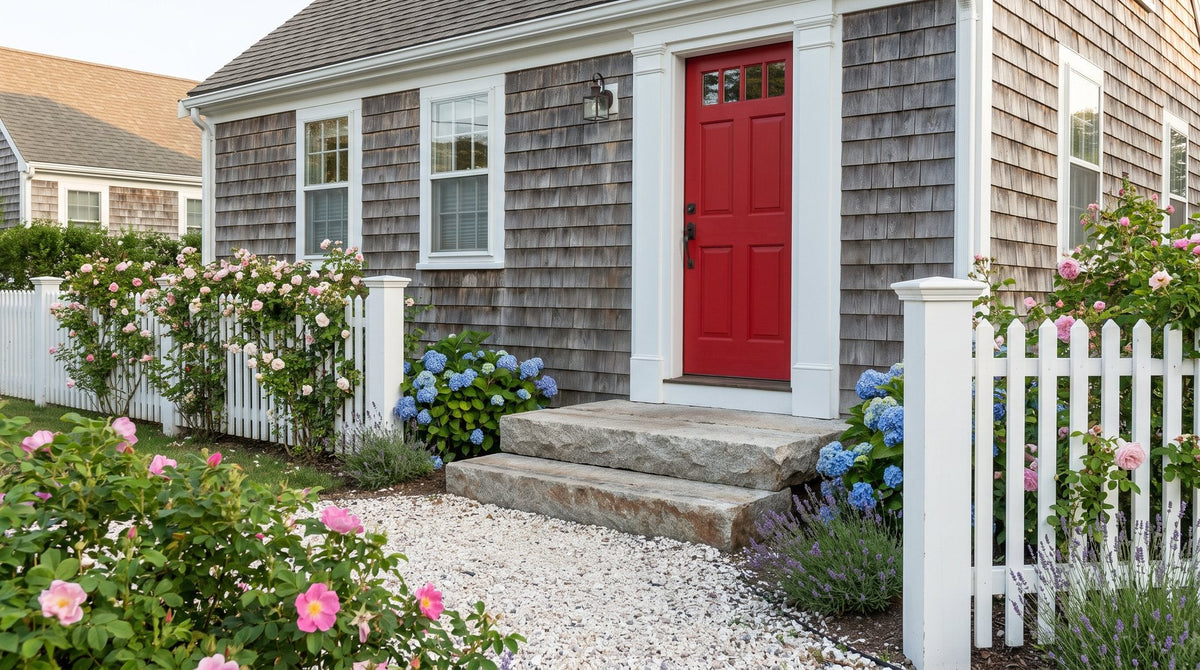
Two old curbs sit side by side in our yard. One is grey granite flecked with tan and rust, heavy and crystalline, with drill marks along one edge. The other is blue-gray bluestone, smoother and a little thinner, with soft layered edges. Both spent decades on a street in the Northeast. Both make excellent steps. Which one belongs at your front door?
Our reclaimed granite and reclaimed bluestone curbstone steps come in the same 2- to 8-foot lengths and the same 14- to 20-inch depths, and they install exactly the same way. The real differences are the stone itself: color, weight, how it wears in winter, and price.
Maybe you are a homeowner who likes both and cannot decide. You might be a designer matching steps to a facade or a patio already on the drawings. Or maybe you are a contractor pricing a stair and want to know what the heavier stone means for the crew. This guide compares granite and bluestone curbstone steps side by side so you can choose with confidence.
| Category | Reclaimed Granite Curbstone Steps | Reclaimed Bluestone Curbstone Steps |
|---|---|---|
| Stone | Granite: hard, crystalline, no layers | Bluestone: a dense sandstone formed in layers |
| Color | Grey with tan and rust tones | Blue-gray to charcoal, sometimes with rust or tan |
| Lengths | 2 to 8 feet | 2 to 8 feet |
| Depth | About 14 to 20 inches | About 14 to 20 inches |
| Thickness | About 5 to 7 inches | About 4 to 6 inches |
| Weight | About 120 lb per linear foot | About 100 lb per linear foot |
| Price per linear foot* | $59 (2–4 ft), $69 (5–6 ft), $79 (7–8 ft) | $79 (2–4 ft), $89 (5–6 ft), $99 (7–8 ft) |
| Surface | Weathered split faces, drill marks, softened edges | Walk-worn faces, softened layered edges |
| Winter | Very resistant to frost and de-icing salt | Durable; worn pieces can flake along their layers if salt and water get in |
| Installation | Rests on the step below, 1–2 inch overlap | Same method |
| Pairs best with | Granite cobblestones, Belgian blocks, brick | Bluestone slabs and walks, brick |
Note: Both are reclaimed natural stone, so every piece varies in color, edges and exact size. Pictures are an indication only.
Granite and bluestone look a little alike from across the street, but they are very different rocks.
Granite formed from cooled molten rock deep underground. It is a mass of interlocking crystals with no layers, which makes it extremely hard and dense. That is why cities used it for the curbs that took the most punishment, and it is the same stone as our reclaimed cobblestones.
Bluestone is a dense, fine-grained sandstone, laid down in layers over millions of years and quarried in the Hudson Valley and nearby Pennsylvania. Its layers are what let it be split into flat slabs and curbs, and they give old bluestone its soft, stepped edges. Our article on what makes reclaimed bluestone different looks at that character in detail.
For most people, this is the deciding factor.
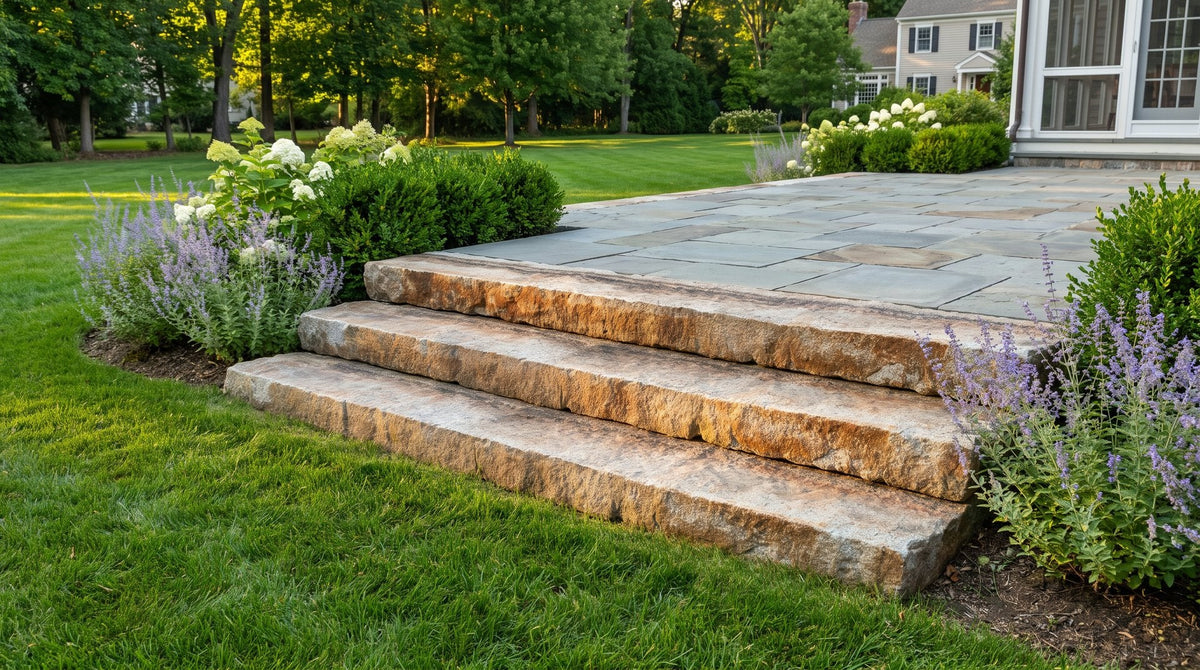
Reclaimed granite curbstone steps are grey, speckled with darker and lighter crystals, and warmed by tan and rust tones from decades of weather. Many pieces still show the drill and split marks left by the stonecutters. The look is rugged, architectural and a little industrial.

Reclaimed bluestone curbstone steps are blue-gray to charcoal, with a finer grain and a smoother, walk-worn face. The look is calmer and more refined, the stone you see on the stoops of old townhouses and brownstones.
Neither is better. Granite reads stronger and warmer; bluestone reads quieter and cooler. Put a sample of each next to your brick, siding or paving and the right one is usually obvious.
Both come in the same lengths and depths, so a granite step and a bluestone step of the same length cover the same tread. The difference is thickness. Granite curbs run about 5 to 7 inches thick and bluestone about 4 to 6, so granite gives you a slightly taller rise per step. On a tall rise, bluestone may take one step more.
Granite is also heavier: about 120 lb per linear foot against about 100 for bluestone. A 5-foot granite step weighs around 600 lb; the same bluestone step about 500 lb. Both need a crew or a machine, but plan for a little more lifting power with granite.
Granite is the less expensive of the two, by $20 per linear foot at every length.
| Example | Granite* | Bluestone* |
|---|---|---|
| One 4-foot step | $236 | $316 |
| One 5-foot step | $345 | $445 |
| One 8-foot step | $632 | $792 |
| Garden stair: four 4-foot steps | $944 | $1,264 |
| Front entry: four 5-foot steps | $1,380 | $1,780 |
Installation costs about the same for either stone, since the method is identical. Shipping is quoted by weight, so a granite order weighs a little more than the same bluestone order. Our curbstone steps calculator prices both: pick the stone, the step length and the number of steps.
Both stones have already survived decades of Northeast winters as curbs, so either will last for generations as a step.
Granite has the edge in the harshest conditions. With no layers and very little open pore space, it shrugs off freeze-thaw and de-icing salt. Bluestone is dense and durable too, but it is a layered stone, and a worn piece that already shows open layers can flake further if salt and water keep getting in. On a north-facing entry that you salt all winter, granite is the safer choice.
Whichever you choose, skip rock salt (sodium chloride). Use calcium chloride or magnesium chloride sparingly, or sand for traction. Our guide on how to de-ice granite steps safely covers the details, and how to care for reclaimed bluestone covers bluestone.
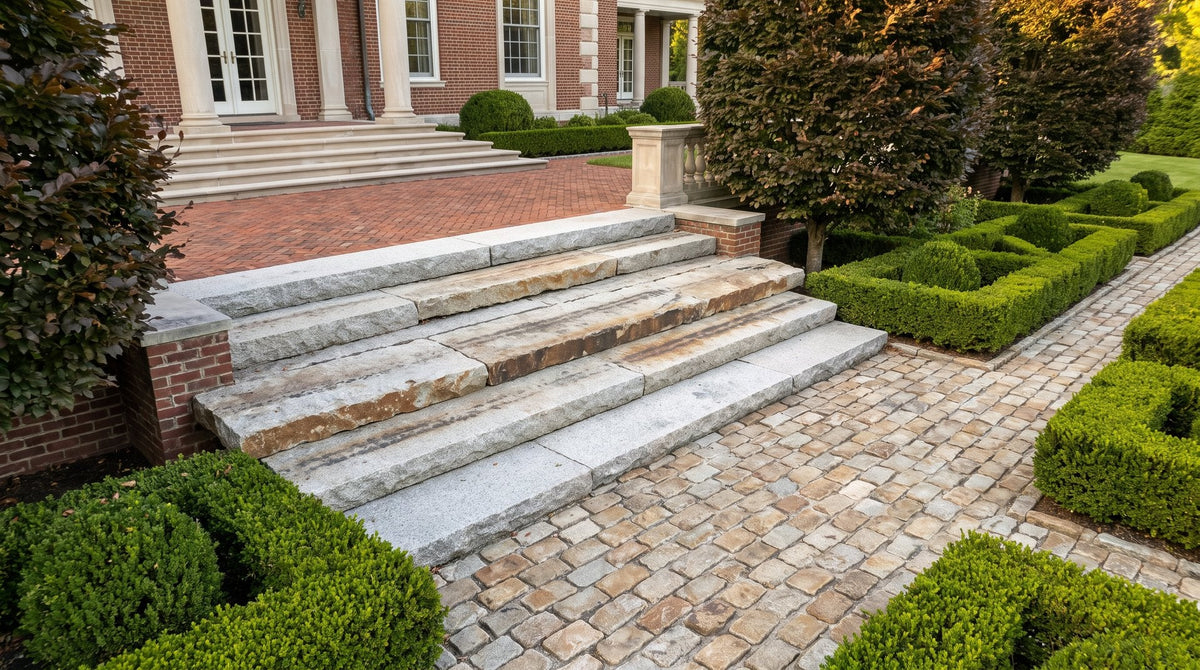
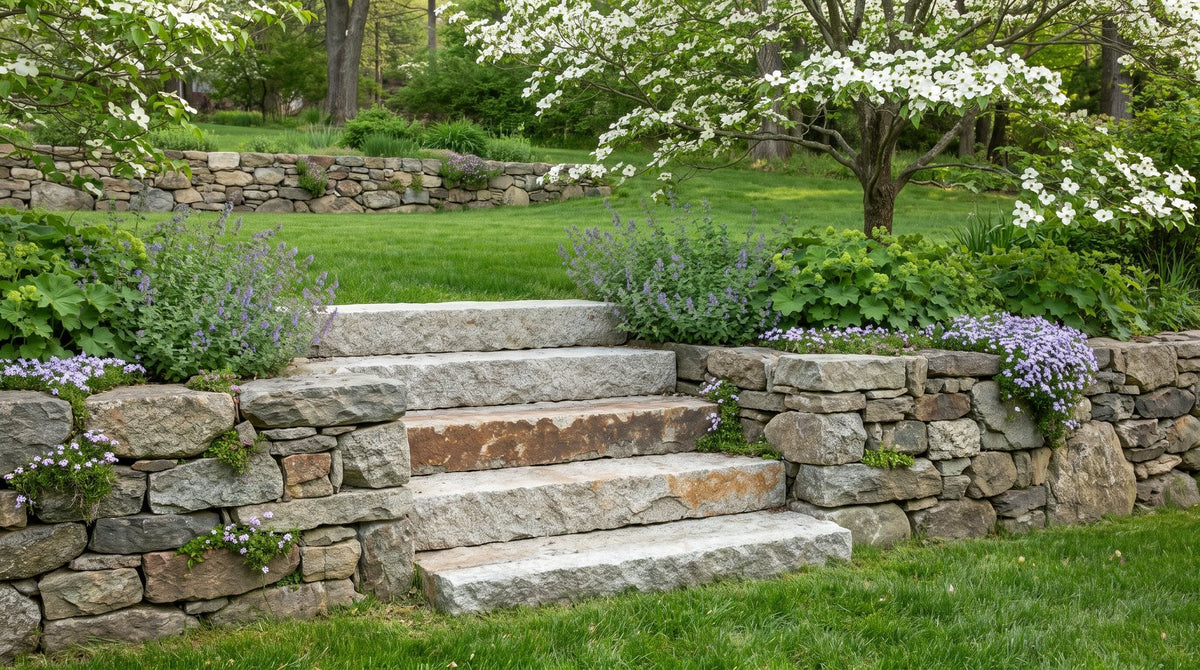
Both stones are set the same way: from the bottom up, on a compacted crushed-stone base or a concrete pad at the front door, with each step resting 1 to 2 inches on the one below and compacted fill behind it. Each tread is pitched slightly forward so water runs off.
Our step-by-step guides cover each stone: how to install reclaimed granite curbstone steps and how to install reclaimed bluestone steps.

As a rule, pick one stone for the stair and repeat it nearby, at a landing, threshold or garden step, so the property reads as one design. Mixing the two in the same stair rarely looks intentional. For paving ideas, see combine bluestone, antique brick and cobblestone.
Both stones ship across the United States on pallets of up to four steps. Add the steps to your cart and enter your address for a shipping quote. If it looks too high, call us at (718) 379-1232; we sometimes have alternative ways to get your steps to your door for a more reasonable price.
The best way to choose is to see them together. Visit our yard in Nanuet, NY (Rockland County), Monday to Friday from 7am to 3pm. No appointment is needed, but if you call ahead at (718) 379-1232, we will make sure you get our full attention.
If you want the toughest stone at the lowest price, or your paving is cobblestone, choose granite. It is harder, more salt-resistant and $20 a foot less, and its grey, tan and rust tones match our reclaimed cobblestones exactly.
If your walk is bluestone, or you want the cool blue-gray of a classic Northeast stoop, choose bluestone. It is a little lighter to handle and has a smoother, more refined face.
Either way, you get a solid, single-piece step with a hundred years of character, installed the same way and built to last as long again. Shop Reclaimed Granite Curbstone Steps or Reclaimed Bluestone Curbstone Steps.
* Prices as of November 2026, per piece by the unit. Confirm current pricing on each product page before ordering.
The information provided in our guides, installation tips, and blog content is for general reference only. Every project is unique, and site conditions can vary. We strongly recommend consulting a qualified professional installer to review your specific project and provide final guidance.

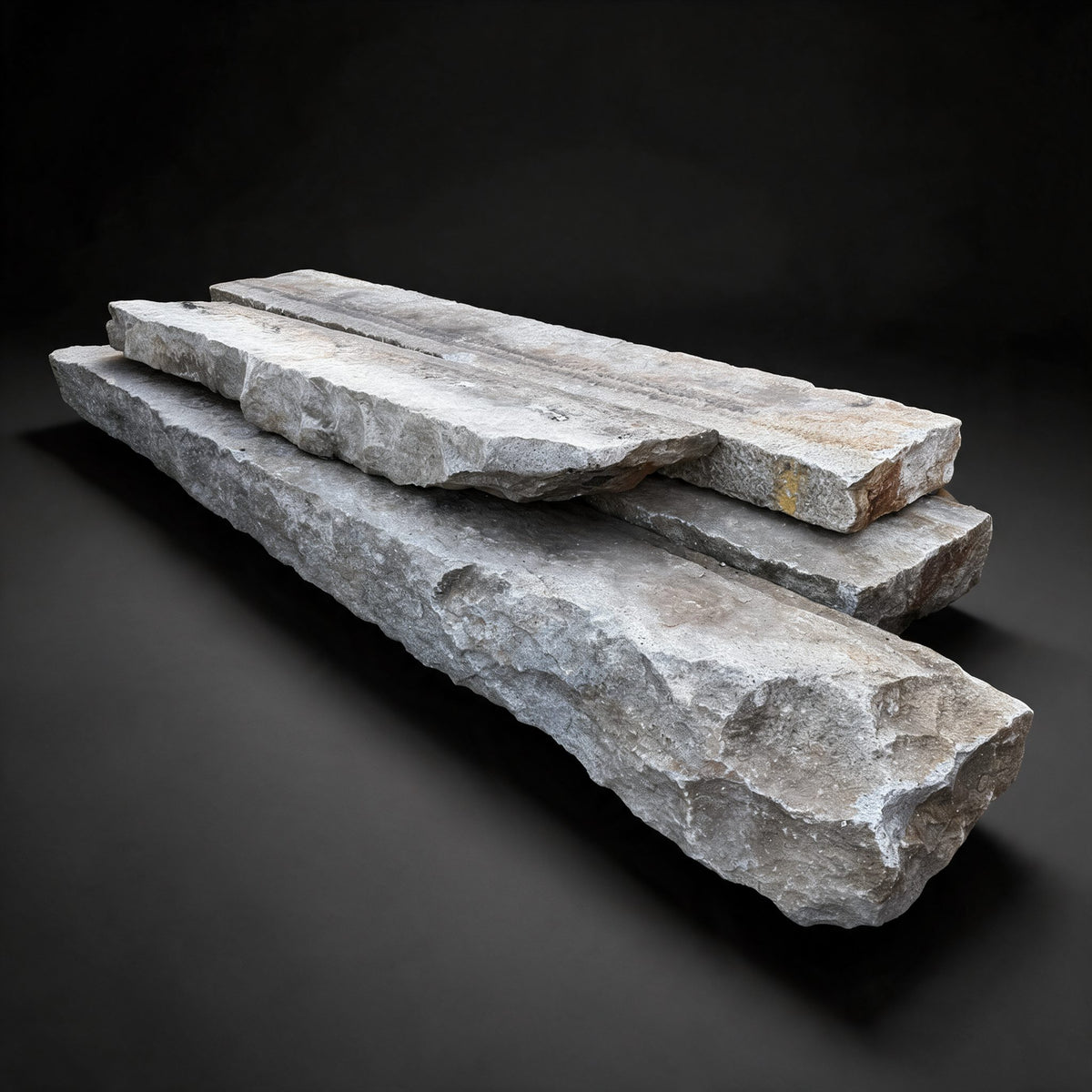

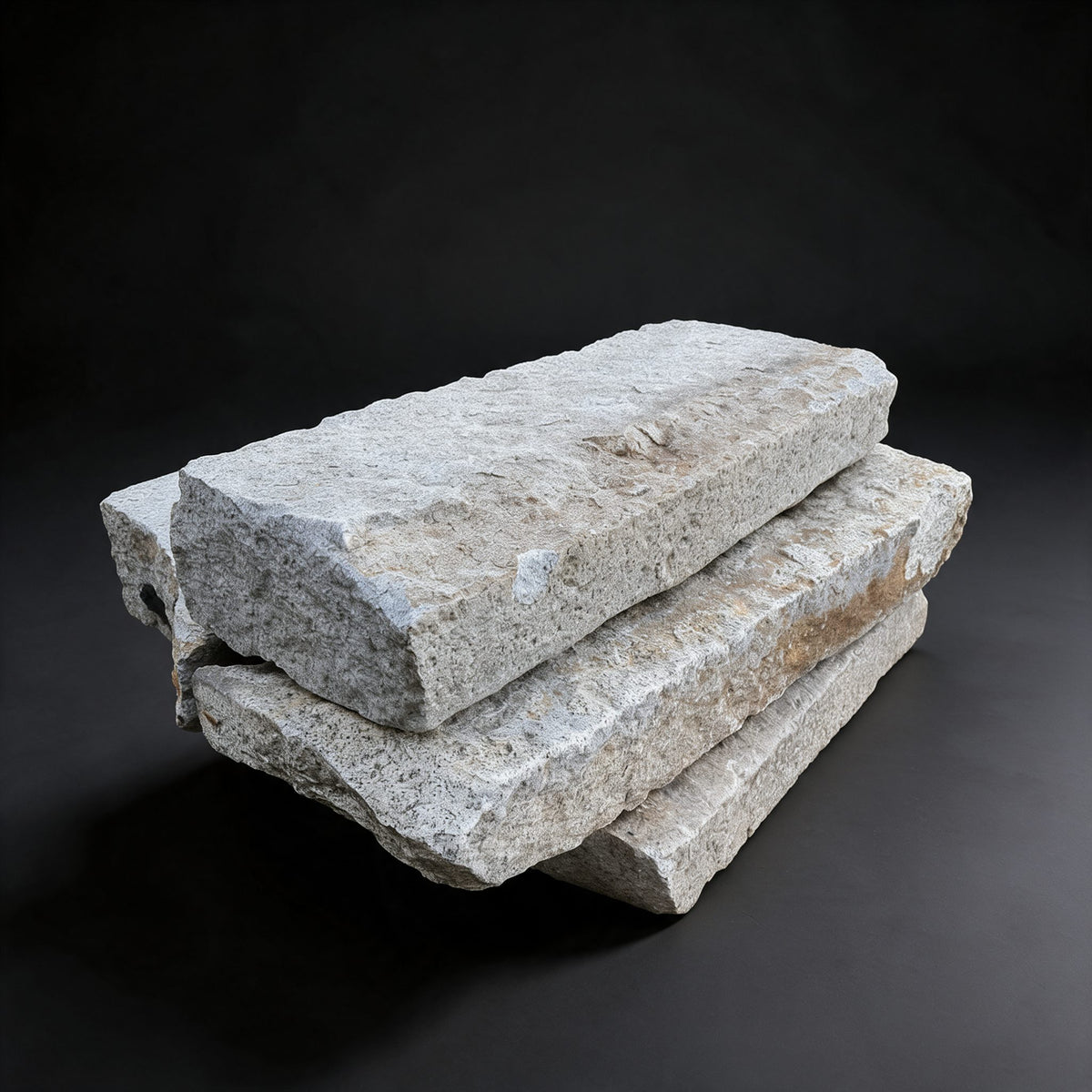
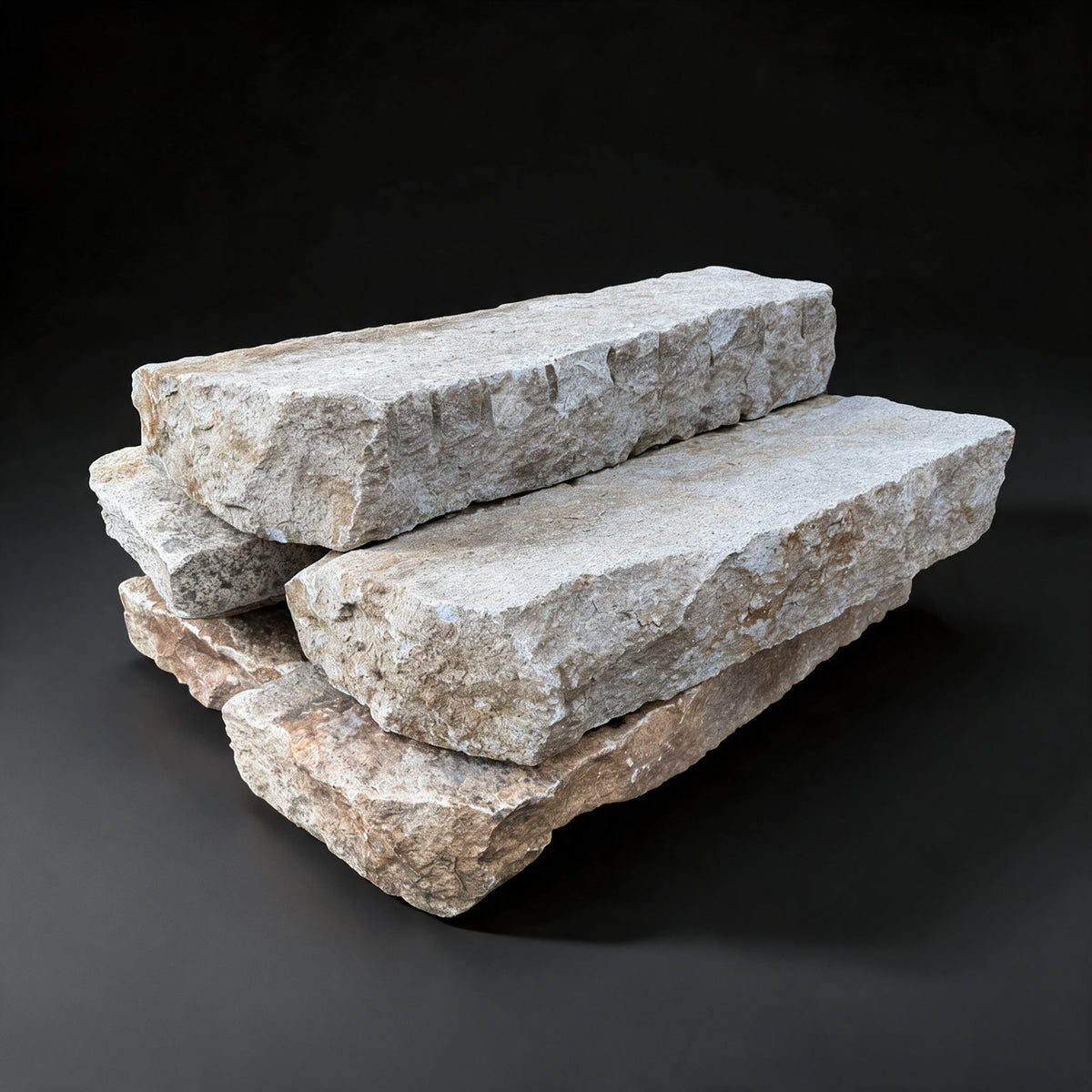
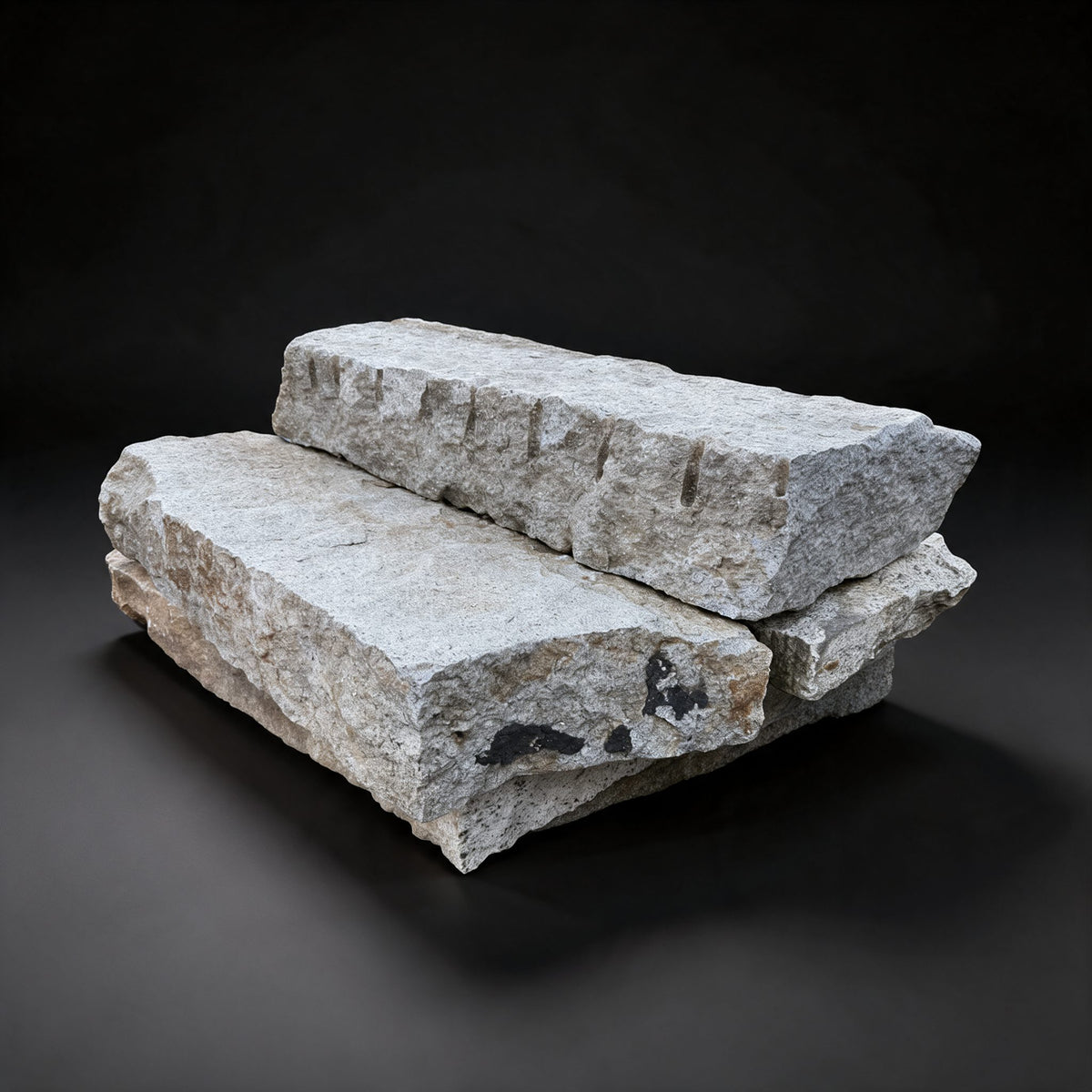
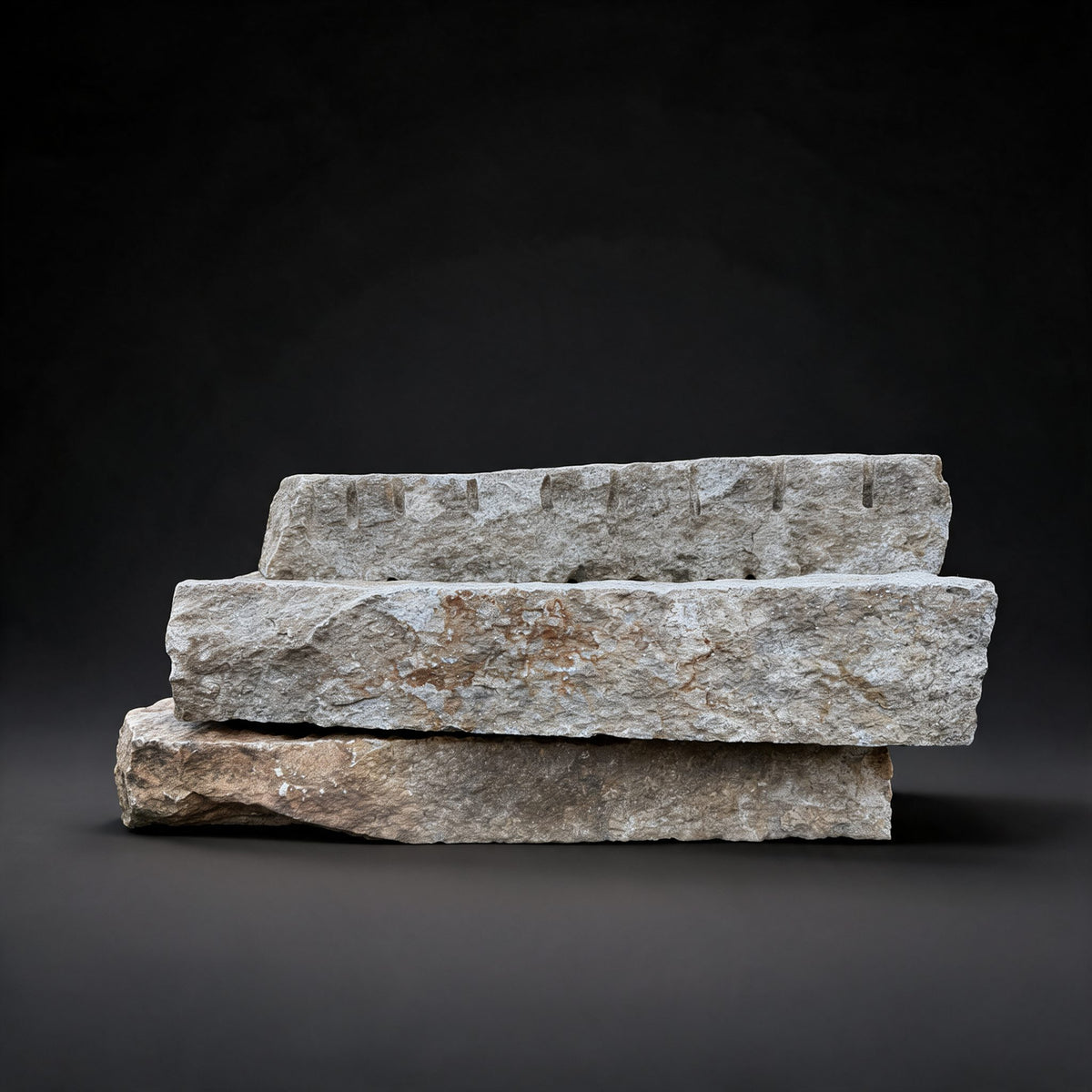


Give a front entry, garden stair or terrace the weight of real New York stone with Reclaimed Granite Curbstone Steps. These are solid granite curbs salvaged from streets and sidewalks in New York and the surrounding region. We keep them out of the landfill and select whole pieces that set well as steps, treads and landings.
They are the same granite as our reclaimed granite cobblestones: dense, hard-wearing and made for decades of traffic, frost and de-icing salt. Years on the street left softened edges, weathered split faces and grey stone with natural tan and rust tones that new granite can't copy. We offer them in lengths from 2 to 8 feet, about 14 to 20 inches wide and 5 to 7 inches thick.
Set them on a compacted gravel base, each step resting on the one below with about a 2" overlap, the same way as our reclaimed bluestone curbstone steps. Work out how many steps you need with our curbstone steps calculator.
They pair well with our reclaimed granite regulation cobblestones for a landing, walkway or driveway apron in matching stone.
Pictures are an indication only. Feel, look and color differ from item to item.
Share: