
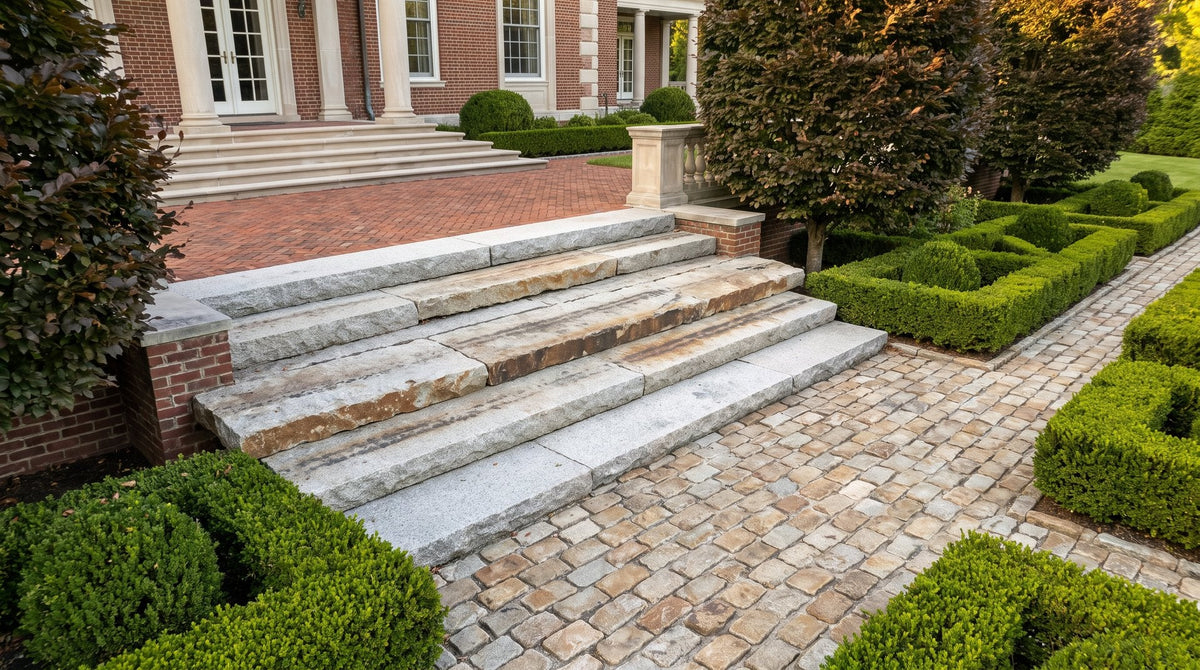
On an old New York street, the cobblestones and the curb were laid together. The curb held the edge, the cobblestones filled the road, and both were cut from the same hard grey granite. A century later, both come out when the street is rebuilt, and they still look like they belong side by side.
That is what makes reclaimed granite curbstone steps and reclaimed cobblestone landings such a natural pair. The long curbs handle the change in height. The small cobblestones handle the flat ground in between: the landing at the door, the walk to the garden, the apron at the drive. Same stone, same weathering, same grey, tan and rust tones.
Maybe you are a homeowner planning a new front entry and wondering what goes at the top of the steps. You might be a landscape designer looking for a paving that ties a stair into a courtyard. Or maybe you are a contractor who needs to know how many cobblestones a landing takes and how the two stones meet. This guide covers layout ideas, landing sizes and stone counts, and the details that make curbs and cobbles work together.
Our Reclaimed Granite Curbstone Steps and our Reclaimed Granite Regulation Cobblestones are the same granite from the same kind of streets in New York and the surrounding region. They weathered side by side, under the same traffic, salt and winters, so their colors and textures match without any effort.
They also work well together in scale. A curb step is long and calm: 2 to 8 feet of unbroken stone. A regulation cobblestone is small and busy: about 9 by 5 inches on its face. Put them together and the long steps frame the cobblestone texture, the way a curb framed the street. Our article on what makes New York cobblestones special tells the story of the stones themselves.
| Layout | Curbstone steps | Cobblestones | Best for |
|---|---|---|---|
| Front-door landing | Two to four steps up from the walk | Landing at the door | Brick and stone houses, townhouses |
| Garden stair with landings | Runs of three or four steps | Small landings between runs | Long slopes and terraced gardens |
| Cobblestone walk with steps | One or two steps at each grade change | The walk itself | Gently sloping front or side yards |
| Apron to door | Steps from the drive to the walk | Driveway apron and walk | Homes with a cobblestone or Belgian block drive |
| Patio step-down | One long step at the patio edge | The patio | Patios a few inches above the lawn |
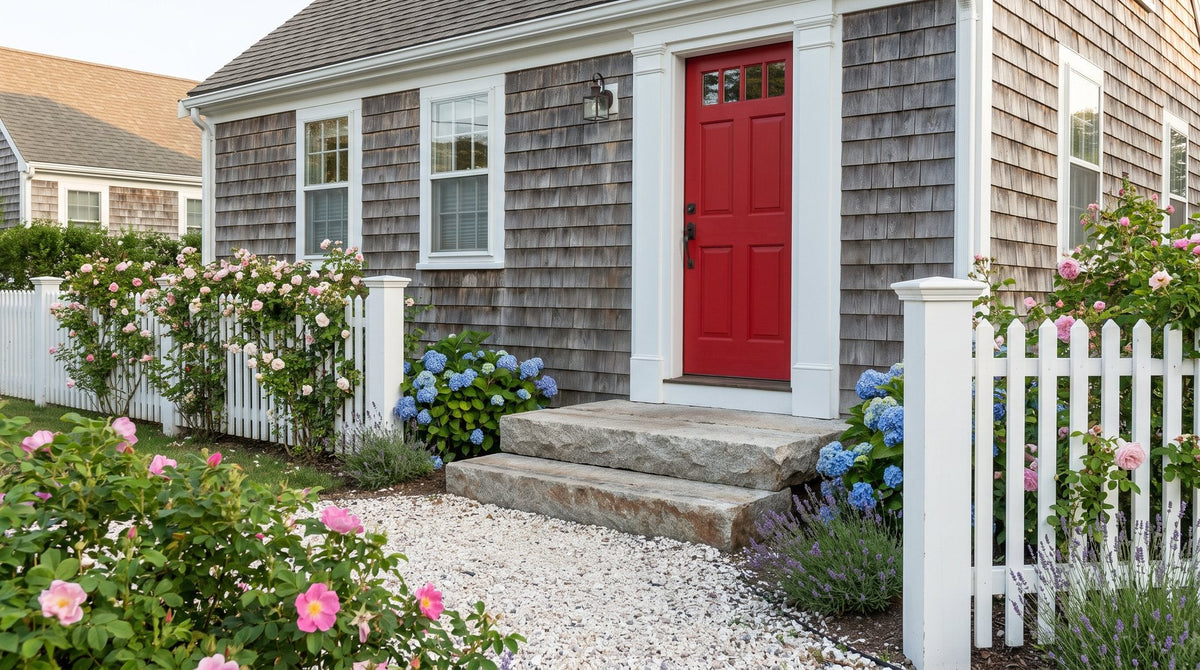
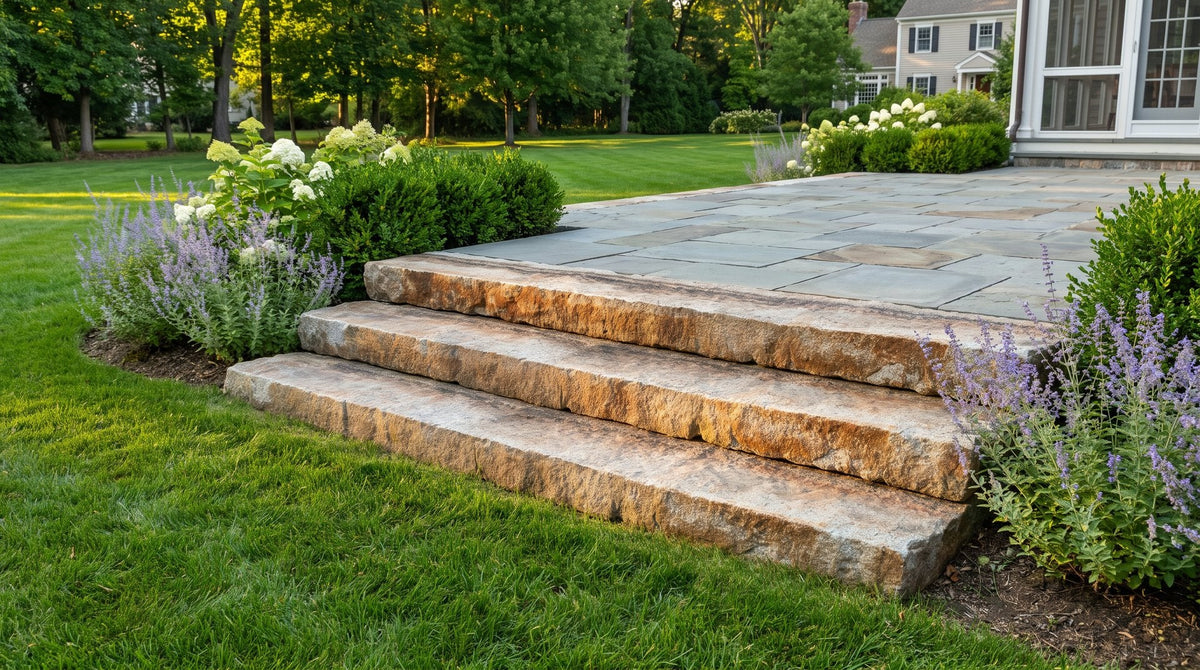
The classic layout: a short run of granite curbstone steps rises from the walk to a cobblestone landing at the door. The steps give the entry its weight, and the landing gives people a place to stand while they find their keys.
Make the landing at least as wide as the door and its trim, and deep enough that someone can stand clear of the door swing, usually 3 to 4 feet or more. Your local code may set a minimum, so check it before you build. A good rule is to make the landing a little wider than the steps below it, so the entry opens up as you arrive.
Lay the cobblestones in a simple running bond, with the long side parallel to the house, and finish the outer edge of the landing with the back of the top step. A border row of cobblestones set the other way around the landing frames it neatly.
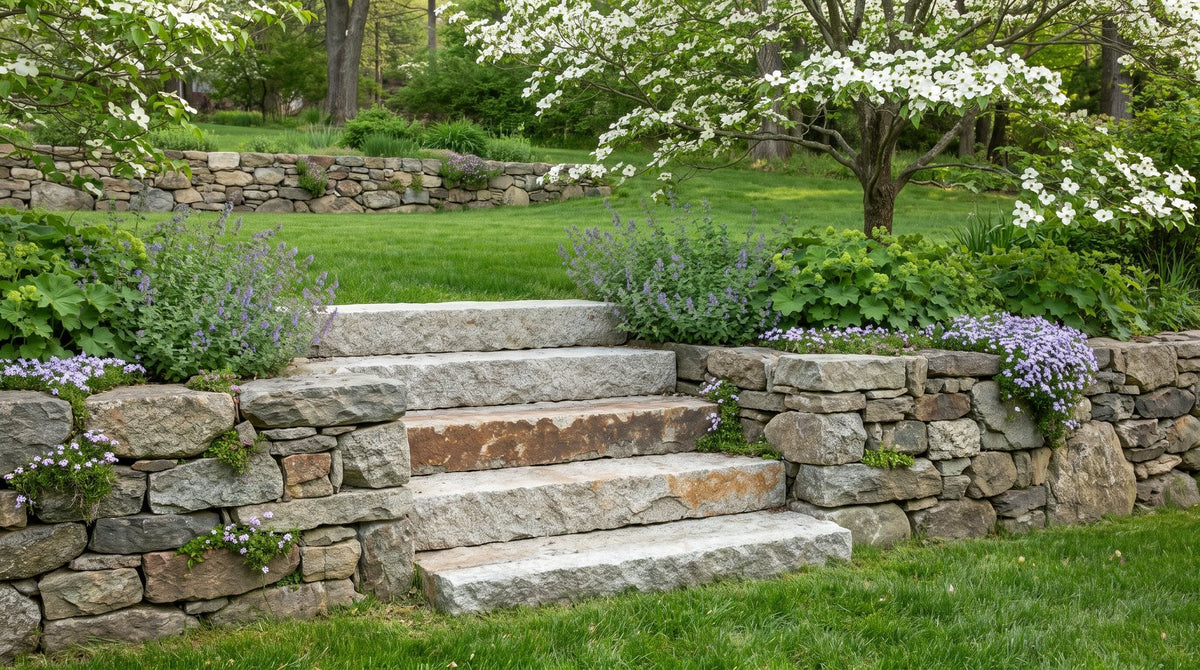
On a long slope, a stair of eight or ten steps in a row feels steep and tiring. Break it into runs of three or four steps with a landing between each run. Small cobblestone landings, 4 by 4 feet or so, give the eye and the legs a rest.
Landings are also the natural place to turn. A stair that climbs straight, turns at a cobblestone landing and climbs again follows the slope better than one that charges straight up, and it feels more like a garden path. Plant the corners of each landing with something low and soft, such as thyme, moss or creeping sedum, and let it spill over the cobblestone edge. For more on long garden stairs, see granite garden stairs and hillside paths.
On a gentle slope, you may not need a stair at all, just a cobblestone walk with a single curbstone step wherever the grade drops 5 or 6 inches. Each step becomes a small event along the path, and the long granite edge reads clearly in the cobblestone texture, which makes the change in height easy to see.

Keep the walk at least 3 feet wide, or 4 feet if two people will walk side by side, and use curbs that span the full width. Edge the walk with a row of cobblestones set lengthwise, or with Belgian blocks, to hold the paving in place.
If your driveway has a cobblestone or Belgian block apron or edging, carry the same stone to the front door. A cobblestone walk leaves the drive, one or two long granite curbs step it up toward the house, and a cobblestone landing waits at the door. Every surface on the way in is the same family of stone.
This is where reclaimed granite curbs really earn their place. Concrete steps between a cobblestone drive and a cobblestone landing always look like an afterthought. Granite curbs look like they were always part of the plan. Our cobblestone driveway guide covers the driveway side.
A cobblestone patio that sits a few inches above the lawn needs one thing: a clean edge to step down from. A single long curbstone along the edge of the patio does the job, holds the cobblestones in place and gives you a broad step to sit on on a summer evening.

For a patio 5 to 7 inches above the lawn, one curb set at the patio edge makes a natural step. For more height, add a second curb below it.
Regulation cobblestones are about 9 by 5 by 5 inches and are laid flat, on their 9-by-5-inch face. With 1-inch joints, they cover about 2.4 stones per square foot. Add about 5% for cuts and sorting, or 10% for herringbone. A full pallet of 178 stones covers about 74 square feet at 1-inch joints.
| Landing size | Area | Stones at 1" joints (+5%) | Approx. cost* |
|---|---|---|---|
| 4 x 4 ft | 16 sq ft | 41 | $318 |
| 5 x 6 ft | 30 sq ft | 76 | $589 |
| 6 x 8 ft | 48 sq ft | 121 | $938 |
| About 70 sq ft | 70 sq ft | 177 | $1,290.50 as one pallet |
Cobblestones are $7.75 each by the unit, or $7.25 each by the pallet of 178*. Our cobblestone and Belgian block calculator works out any landing or walk, with your choice of joint width and pattern, and our curbstone steps calculator does the steps.
Here is a happy coincidence: a regulation cobblestone is about 5 inches tall, and a granite curbstone step is about 5 to 7 inches thick. Set on the same base, a cobblestone landing and a curb step sit within an inch or so of each other, and the bedding takes up the difference. That makes it easy to pave a landing flush with the top of the last step, or to set a landing exactly one step above the step below.
Garden landings and walks are usually dry-laid: about 4 inches of compacted crushed stone and a 1-inch setting bed, the same base the steps sit on. Where the landing meets the house, or anywhere cars will drive, many installers set the cobblestones in mortar over a concrete base with 1-inch mortar joints. Check local code and frost depth at the door. Our guides on how to install reclaimed granite curbstone steps and the reclaimed cobblestone guide cover each part.
Butt the cobblestones tight against the back of the top step, with a normal joint between them, so the curb acts as the edge restraint for the landing. Pitch the landing away from the house about 1/4 inch per foot so water runs off toward the steps and away from the door. Keep joints consistent, about 1 inch, so the landing reads as one surface. For upkeep, see our cobblestone care guide.
We ship steps and cobblestones together across the United States. Cobblestones are sold by the unit or by the pallet, and steps ship on pallets of up to four pieces. Add both to your cart and enter your address for a shipping quote. If it looks too high, call us at (718) 379-1232; we sometimes have alternative ways to get your stone to your door for a more reasonable price.
Want to see them side by side? Visit our yard in Nanuet, NY (Rockland County), Monday to Friday from 7am to 3pm. No appointment is needed, but if you call ahead at (718) 379-1232, we will make sure you get our full attention. You can also order a single cobblestone as a sample.
If you want an entry or garden stair that looks like it has always been there, yes. Granite curbstone steps with cobblestone landings use the same reclaimed granite throughout, so nothing looks new and nothing looks mismatched. The long steps and small cobblestones balance each other, and both will outlast the house.
The trade-off is labor. Cobblestones take longer to lay than large slabs, and the curbs are heavy. For a simpler, faster landing, a pair of curbs side by side or one of our deep new granite steps can serve as a landing instead. If you are weighing granite against bluestone for the steps, see granite vs bluestone curbstone steps.
Start with our Reclaimed Granite Curbstone Steps and Reclaimed Granite Regulation Cobblestones.
* Prices as of November 2026. Confirm current pricing on each product page before ordering.
The information provided in our guides, installation tips, and blog content is for general reference only. Every project is unique, and site conditions can vary. We strongly recommend consulting a qualified professional installer to review your specific project and provide final guidance.

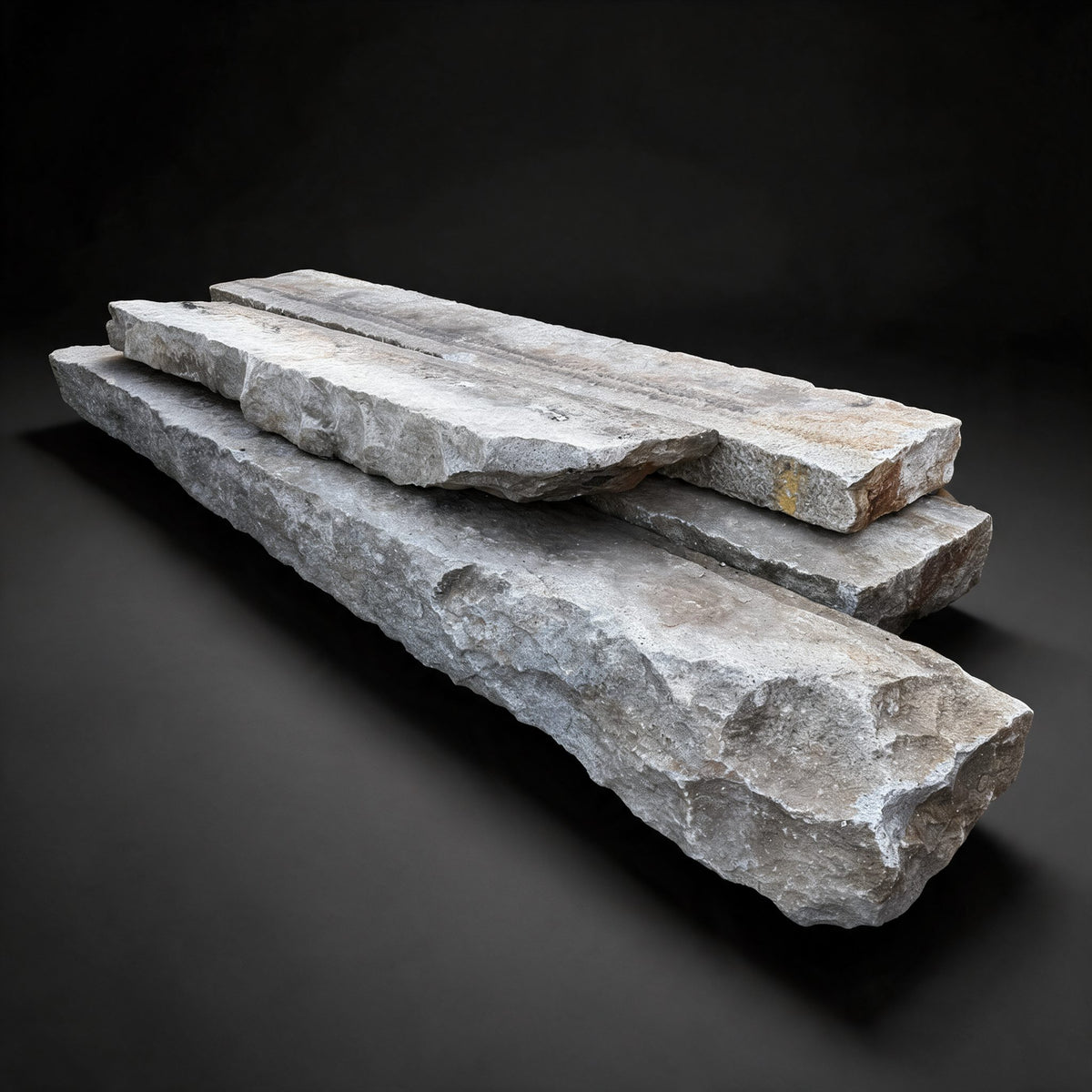

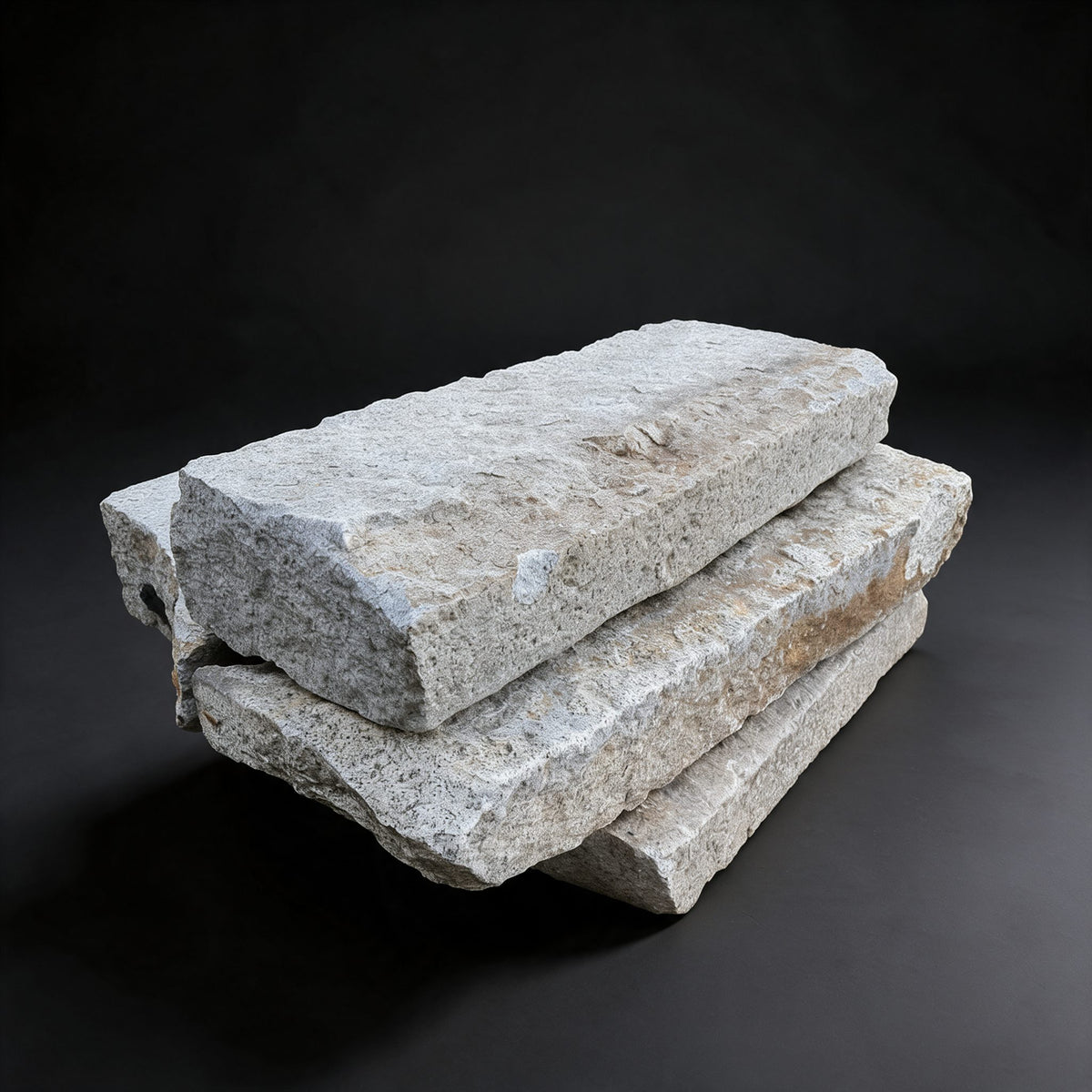
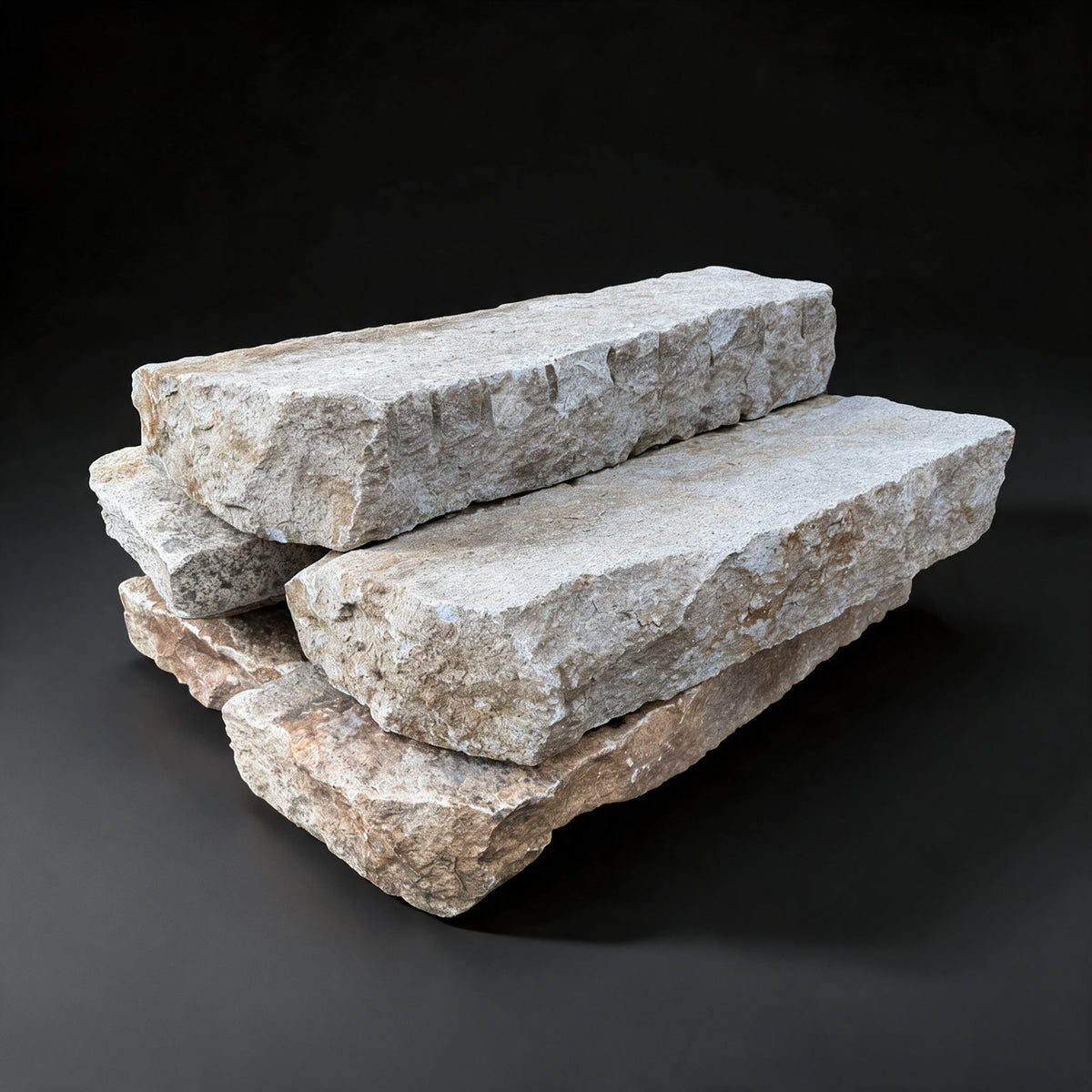
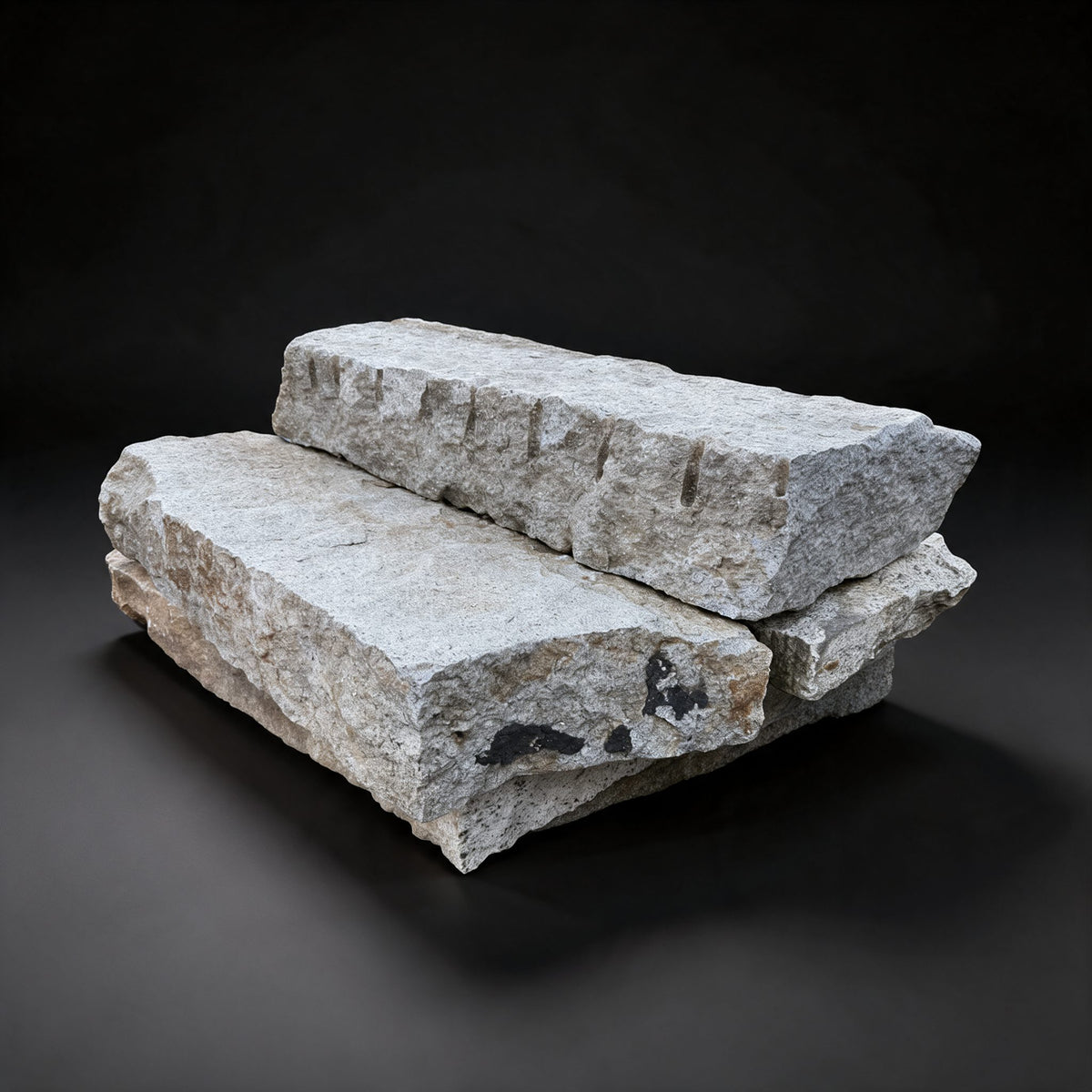
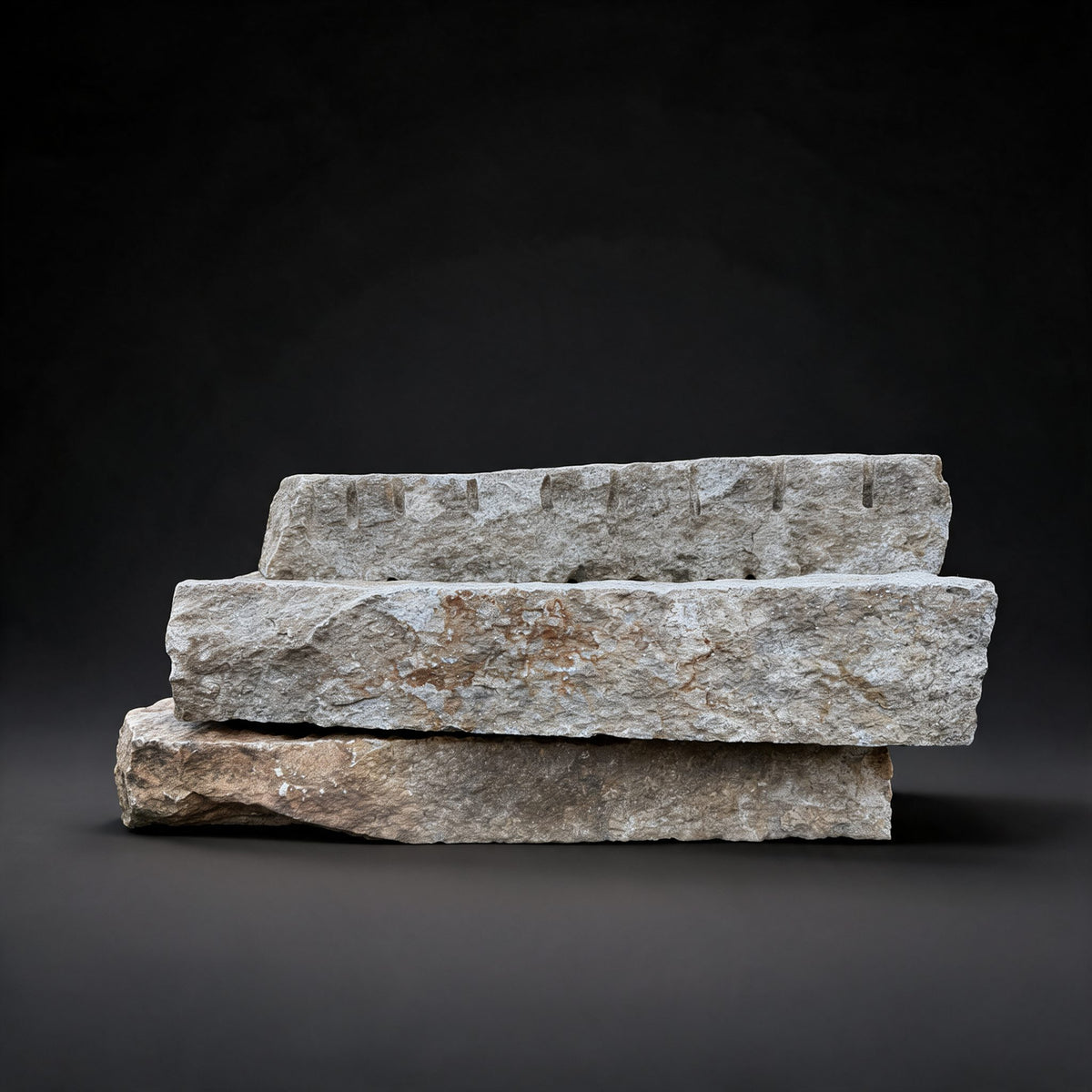


Give a front entry, garden stair or terrace the weight of real New York stone with Reclaimed Granite Curbstone Steps. These are solid granite curbs salvaged from streets and sidewalks in New York and the surrounding region. We keep them out of the landfill and select whole pieces that set well as steps, treads and landings.
They are the same granite as our reclaimed granite cobblestones: dense, hard-wearing and made for decades of traffic, frost and de-icing salt. Years on the street left softened edges, weathered split faces and grey stone with natural tan and rust tones that new granite can't copy. We offer them in lengths from 2 to 8 feet, about 14 to 20 inches wide and 5 to 7 inches thick.
Set them on a compacted gravel base, each step resting on the one below with about a 2" overlap, the same way as our reclaimed bluestone curbstone steps. Work out how many steps you need with our curbstone steps calculator.
They pair well with our reclaimed granite regulation cobblestones for a landing, walkway or driveway apron in matching stone.
Pictures are an indication only. Feel, look and color differ from item to item.
Share: