
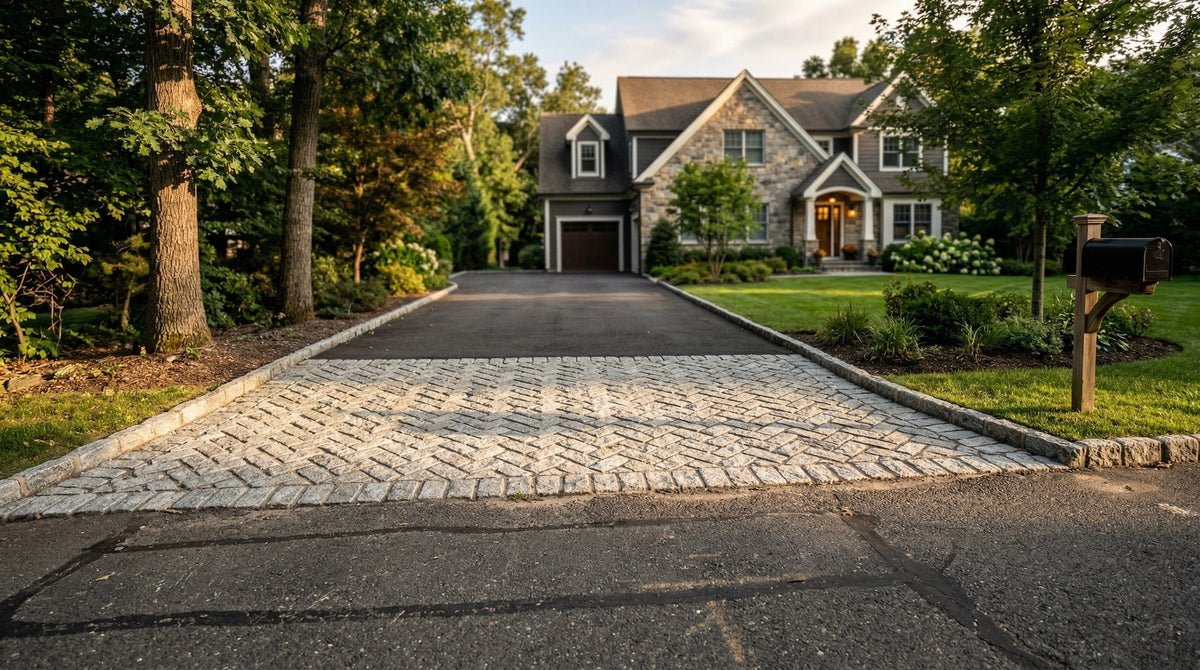
Pull into a driveway paved in old granite and you feel it before you see it: the low rumble of tires over stone, the solid sound underfoot when you step out of the car. Stone gives a house an entrance that feels settled, as if it has always been there. But "stone driveway" covers a lot of ground, and not every stone that looks good on a patio belongs under a car.
This guide is about paved stone driveways: stone set as a paving surface. Gravel appears here only as the base under the stone, never as the surface itself.
Maybe you are a homeowner who wants a driveway with more character than asphalt or concrete. You might be a designer choosing materials for a client's entrance. Or maybe you are a contractor pricing a natural stone driveway and checking which stones are actually suited to it. This guide breaks down the paving stones we sell for driveways, how each is set, what they cost, which stones to keep off the driveway, and how to look after the finished surface.
These are the stones we sell for driveways, with how each is set and what the material costs per square foot.
| Stone | Size (L x W x H) | Role on a driveway | How it is set | Material per sq ft* |
|---|---|---|---|---|
| Reclaimed cobblestone, Jumbo XL | 12" x 8" x 5" | The whole driveway surface | Mortar on a concrete base, 1" joint | About $15.07 ($12.61 by the pallet) |
| Reclaimed cobblestone, Jumbo | 11" x 7" x 4" | The whole driveway surface | Mortar on a concrete base, 1" joint | About $14.63 ($13.13 by the pallet) |
| Reclaimed cobblestone, Regulation | 9" x 5" x 5" | The whole driveway surface | Mortar on a concrete base, 1" joint | About $18.60 ($17.40 by the pallet) |
| Reclaimed cobblestone, 7" cube | 7" x 7" x 7" | The whole driveway surface | Mortar on a concrete base, 1" joint | About $18.56 |
| Reclaimed Flint street pavers | 8" x 3.75" x 2.75" | The whole driveway surface | Sand-set over compacted gravel, laid tight; stone dust or coarse sand in the joints | About $18.00 ($16.80 by the pallet), laid tight |
| Granite Belgian block, Jumbo and Regulation | 10" x 7" x 4"; 9" x 5" x 5" | The whole driveway surface, aprons and edging | Mortar on a concrete base; edging on a 4-6" concrete bed, 1" joint | Priced per stone; see the Edging Calculator |
Note: cobblestone costs are worked at a 1" joint; Flint is laid tight with no joint. Our 5" and 6" cobblestone cubes can also be used on a driveway when they are set in mortar on a concrete base. The 12" x 6" x 3" Belgian block paver is for edging and borders, not the driveway surface.
A stone driveway, in this guide, is natural stone laid as a paving surface: stones set side by side to make the surface you drive on. Underneath, a compacted gravel base and, for cobblestone and Belgian block, a concrete base do the hidden work. The stone you see is the finished surface.
For that surface, we sell reclaimed granite cobblestones and new granite Belgian blocks, and also reclaimed Flint street pavers. Flint pavers are reclaimed clay brick, not stone; we include them because they were made for street paving and suit a driveway. Several other paving stones look at home in a garden but aren't made to carry cars; we cover those further down.
Reclaimed cobblestones are the classic natural stone driveway pavers. Ours are weathered gray granite from New York and the surrounding region, sorted by hand. They come in Jumbo XL (12" x 8" x 5"), Jumbo (11" x 7" x 4"), Regulation (9" x 5" x 5") and cubes, and the 7" cube is a natural fit for driveways and entrances.
On a driveway, cobblestones are set in mortar on a concrete base, with a 1" joint. Set that way, granite cobblestones can last decades, and a single damaged stone can be lifted and replaced without breaking up the whole surface.
Our cobblestone driveway guide goes deeper into the look, the trade-offs and the installation steps. For sizes, weights and other uses, see our reclaimed cobblestone guide.
Belgian blocks are new granite from our own dedicated quarry in India, cut to a more even shape than reclaimed cobblestones. Our Jumbo (10" x 7" x 4") and Regulation (9" x 5" x 5") Belgian blocks can pave a whole driveway, just as reclaimed cobblestones can. They also make the edging along the sides and the apron where the driveway meets the street.
On a driveway or an apron, they are set like cobblestones: in mortar on a concrete base. Sizes are a style choice, but common practice is Jumbo for edging and Regulation for aprons. Belgian block edging is set on a 4-6" concrete bed, with concrete packed up the back to about half the block's height, and laid with a 1" joint. Our 12" x 6" x 3" Belgian block paver is for edging and borders, not the driveway surface.
A Belgian block border or apron can also frame a cobblestone or Flint driveway, or an asphalt one. Our guide to driveway edging and aprons with granite Belgian blocks shows the common styles, and the Belgian block and cobblestone edging calculator works out the stones for each run.
Flint street pavers aren't stone: they are reclaimed clay brick, old street pavers that are 8" x 3.75" x 2.75" and about 7 lb each, and every one carries its original "Flint Co" stamp. They were made for street paving and are suited to driveways.
Flint pavers are laid tight, with no joint, at about 4.80 pavers per square foot. On a driveway, they are sand-set over compacted gravel, and stone dust or coarse sand is swept into the joints. Polymeric sand isn't part of the method.
Our article are reclaimed brick street pavers right for your driveway? covers patterns, edges and costs in more detail.
Some of our paving stones are beautiful underfoot but are not meant to carry cars. If a driveway is in the plan, keep these for the walks, patios and rooms around it:
A walk or patio in one of these stones can sit right next to a stone driveway and tie the two together. Just keep the cars on the driveway stone.
The base is what makes a stone driveway last. For cobblestone and Belgian block, on a driveway or an apron, the rule is simple: the stones are set in mortar on a concrete base. Setting stone on sand is for walks and patios only, not for driveways.
Flint street pavers are the exception: on a driveway, they are sand-set over compacted gravel, laid tight, with stone dust or coarse sand in the joints.
This is the outline, not a full installation plan. For the steps in more detail, see our cobblestone driveway guide, and have an experienced installer plan the base for your site.
A natural stone driveway costs more than asphalt or concrete, mainly because of the skilled labor. These are typical installed costs per square foot*:
| Driveway | Installed cost per sq ft* |
|---|---|
| Reclaimed cobblestone | About $28-46 |
| Reclaimed Flint street pavers | About $36-44 |
| Concrete pavers, for comparison | About $12-30 |
| Granite Belgian block | Labor about $12-24 per sq ft, plus the stone; see below |
Note: these ranges include stone and installation. Extra base work, removal of an old driveway, edging and drainage are priced separately.
Two ways to keep the budget in hand:
When you order, add about 10% for simple layouts and 12-15% for curves, borders and herringbone. Our Masonry Brick & Stone Calculator works out the stones for the driveway surface. For example budgets, see our reclaimed cobblestone driveway cost guide and our Belgian block driveway cost guide.
A well-built stone driveway asks for little. Sweep it, rinse it now and then, and walk it each spring and fall to check the joints. A joint that has opened up is easier to fill early than to repair later.
Weeds can find their way into joints, especially on sand-filled walks and patios next to the driveway. Pull them while they are small. Our guide to removing weeds between cobblestones covers the methods, and our reclaimed cobblestone maintenance guide covers cleaning and care.
If you want an entrance with real character that can last decades, yes. Reclaimed cobblestones and Flint street pavers bring real age, granite Belgian blocks bring a cleaner, more even look, and Belgian block edging and aprons give any driveway a crisp frame. Set well, stone also lets you replace a single damaged piece instead of a whole slab.
The trade-offs are real. A stone driveway costs more than asphalt or concrete, it needs a skilled installer and a proper base, and the surface is less even than a slab, which matters for shoveling and wheels. Choose the right stone for the job, and keep the thin stones for walks and patios.
To see the stones, start with our cobblestone driveway guide, or visit our yard in Nanuet, NY. No appointment is needed, but if you call ahead at (718) 379-1232, we will make sure you get our full attention.
* Prices as of November 2026. Confirm current pricing on each product page before ordering.
The information provided in our guides, installation tips, and blog content is for general reference only. Every project is unique, and site conditions can vary. We strongly recommend consulting a qualified professional installer to review your specific project and provide final guidance.
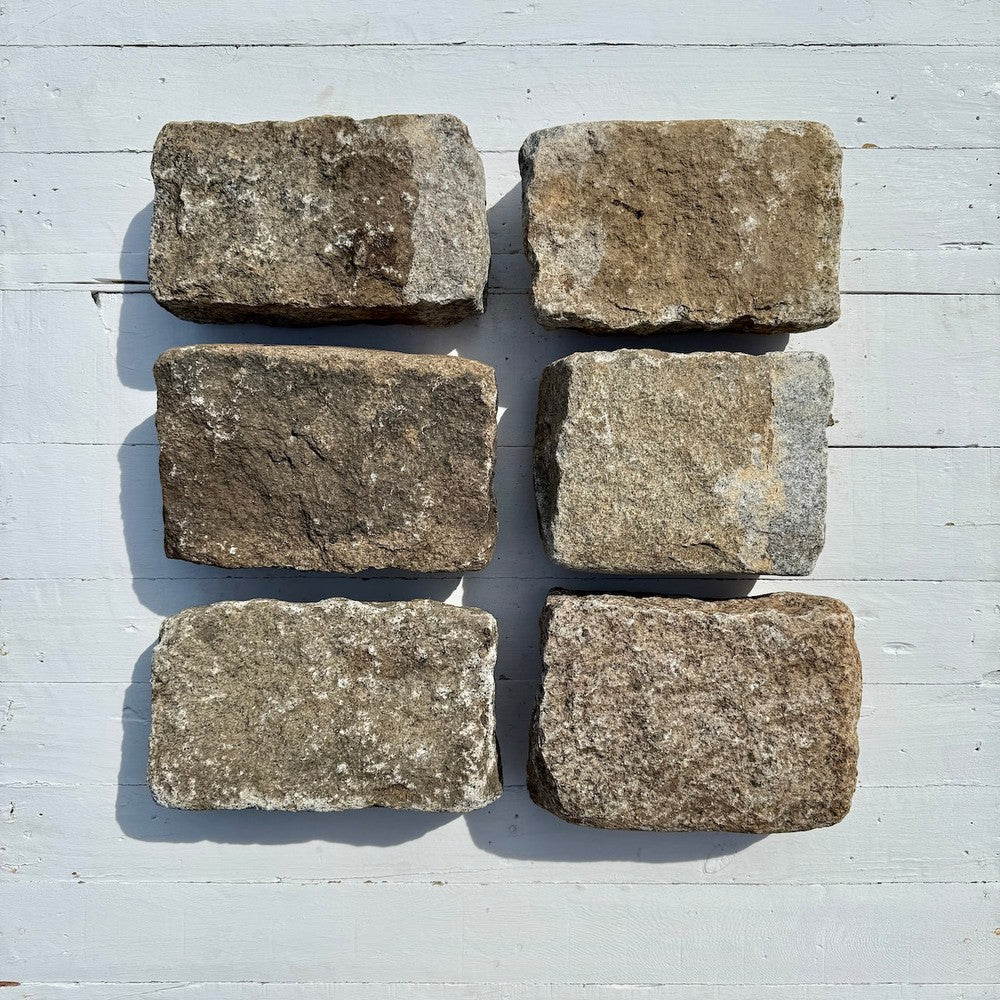
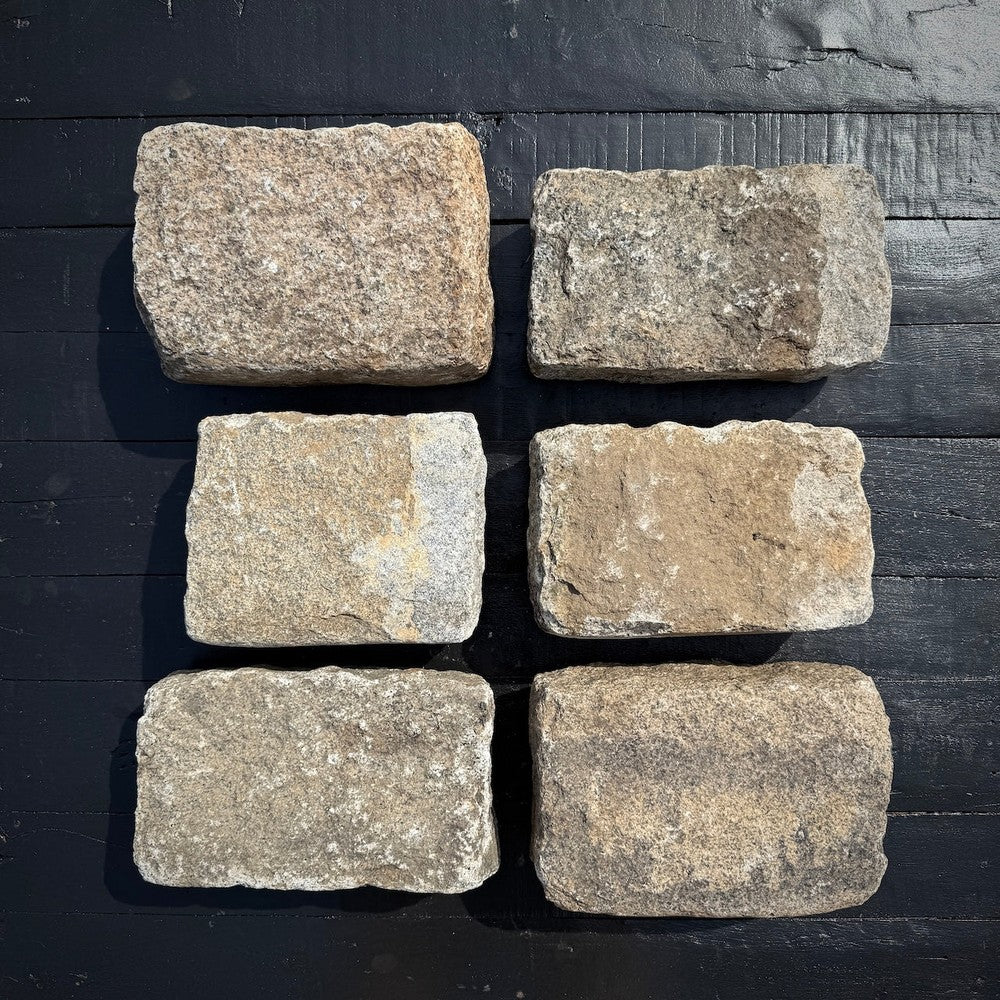


Make a bold statement with Chief Bricks’ Reclaimed Jumbo Cobblestones, expertly salvaged and repurposed in impressive 11” x 7” x 4” dimensions. As cobblestone pavers, they are set in mortar on a concrete base for driveways, or on sand for walks and patios, with a 1" joint. These oversized cobblestones add a touch of historic charm and enduring character to driveways, walkways, patios, and terraces. Their larger size and unique weathered texture make them perfect for creating rustic, timeless outdoor spaces.
Work out how many bricks or stones you need for your wall, patio or walkway with our Masonry Brick & Stone Calculator. Work out how many Belgian blocks or reclaimed cobblestones you need for your edging with our Belgian Block & Cobblestone Edging Calculator.
Pictures are an indication only. Feel, look and color differ from item to item.

Share: