There is a reason reclaimed brick walls feel different. It is not just the color and the rounded corners. It is the idea that the material has already done a lifetime of work and still has more to give. When you care about sustainability, that story matters as much as the look.
But the brick is only half of it. The mortar you choose can either support that low‑waste, low‑carbon story or quietly work against it. Build a reclaimed wall with a brittle, hard‑to‑repair mortar, and you are locking future owners into demolition when things go wrong. Pair reclaimed bricks with a lime‑based mortar, and you are designing a wall that wants to be repaired instead of replaced.
Maybe you are an architect working toward a LEED or embodied-carbon target. You might be a homeowner who wants a wall that is as good for the planet as it looks. Or maybe you are a contractor explaining the choice to a client who has only ever used cement.
This article looks at reclaimed bricks and lime mortar as a team: how they cut carbon and waste, how they fit into circular construction, and why they make sense if you want your project to age well instead of simply age out.
Table of Contents
- Why Reclaimed Bricks Are Inherently Sustainable
- How Lime Mortar Supports a Low‑Impact Wall
- Designing for Repair Instead of Replacement
- Tying It Back to Real Projects
- How to Talk About This with Clients and Teams
- Is Lime Mortar Worth It for a Sustainable Wall?
Why Reclaimed Bricks Are Inherently Sustainable
Reclaimed bricks start with one major advantage: they already exist. No new clay needs to be dug, processed and fired at high temperatures. Instead, bricks are carefully salvaged from buildings that are being demolished or remodeled, then cleaned and sorted for reuse. You can read how we do it in how we source, sort and clean reclaimed bricks.
That simple shift—reuse instead of new production—cuts out a big chunk of embodied carbon and energy from your wall. Each reclaimed brick you lay is one less brick that has to make a trip through a kiln. At the same time, you are keeping solid material out of the landfill and out of the crusher, where it would be turned into aggregate or fill.
Because reclaimed bricks have already proven themselves in real weather, they also contribute to durability. A long‑lasting wall is sustainable by nature; the less often you have to rebuild, the fewer resources you consume over the life of the building.
How Lime Mortar Supports a Low‑Impact Wall
Lime mortar brings its own sustainability story to the table. It is made from limestone burned at lower temperatures than modern cement, and as it cures, it absorbs carbon dioxide from the air as it turns back into a stable mineral. Natural hydraulic limes like NHL 3.5 harden partly through this carbonation and partly through a hydraulic set, so over its life a lime‑based wall locks up some of the CO₂ released during production.
Just as important, lime mortars are breathable and flexible. They allow moisture to move through the wall instead of trapping it, and they accept small movements without giving up. That combination keeps masonry assemblies dry and comfortable, which reduces the need for heavy intervention, replacement, and energy‑hungry fixes later on.
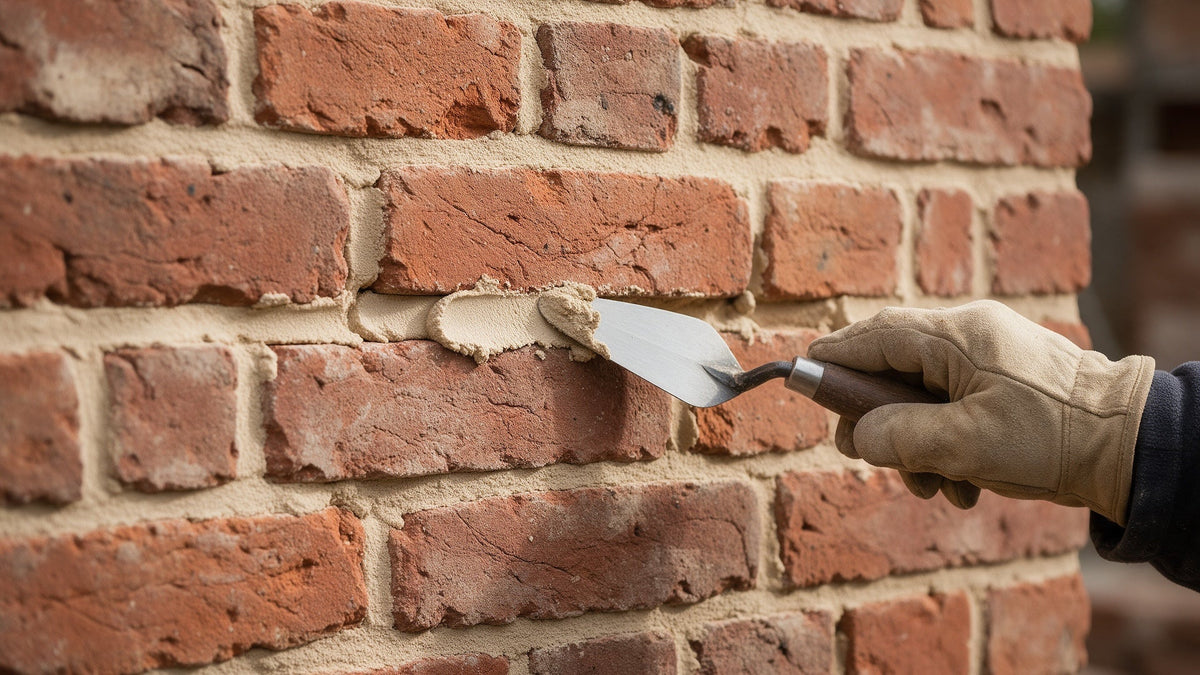
When you eventually do need to work on the wall, lime mortar is easier to remove and replace than very hard, dense cement mixes. That means you can repair local areas, swap damaged bricks and repoint joints without having to strip everything back to the foundation. In a world where we talk about circular economies, that kind of built‑in reversibility is a quiet superpower.
It also closes the loop. Bricks laid in soft lime mortar are far easier to clean and reuse when a building comes down, which is exactly why so many old New York bricks can be reclaimed today. Bricks set in hard cement mortar often break before they come free.
Designing for Repair Instead of Replacement
A truly sustainable wall is not just low‑carbon on day one; it is designed to be repairable on day ten, year ten and beyond. Reclaimed bricks paired with lime mortar naturally push you in that direction.
The brick units are robust and reusable. The mortar is intentionally the weaker, sacrificial layer. When joints eventually tire out, you repoint them. When a brick gets damaged, you can carefully release it from its neighbors and drop in another reclaimed piece. The wall becomes a system you can tune over time instead of a monolithic block that has to be demolished once a few parts fail.
This repair‑friendly approach also makes it easier to respond to changing needs. Openings can be adjusted, services can be threaded through, and local repairs can blend in without leaving obvious scars. You are not just building for yourself; you are leaving options for whoever comes after you.
Tying It Back to Real Projects
On paper, sustainability can sound abstract. On site, it shows up in very tangible ways. A reclaimed brick facade with lime mortar uses less virgin material and less energy up front. It generates less waste during demolition because the bricks and mortar can be separated and reused. It also tends to be more forgiving in everyday use, which cuts down on emergency fixes and early replacements.
For architects and builders working toward certifications or ESG goals, that matters. You can point directly to reduced embodied carbon, landfill diversion, and a design that supports long‑term adaptability. Our guide to LEED credits with reclaimed bricks and stone goes into the details. For homeowners, the story is simpler but just as strong: this is a wall that respects what already exists and is built to be looked after, not thrown away.
Whether it is a townhouse facade, a courtyard wall, or an interior feature, the same logic applies. Reclaimed bricks bring character with a smaller footprint; lime mortar lets that character live comfortably in a breathable, repairable shell.
How to Talk About This with Clients and Teams
Most people intuitively like the idea of “sustainable,” but they are not always sure what it means day to day. Framing reclaimed bricks and lime mortar in clear, practical terms helps everyone see the value.
With clients, focus on three points: you are reusing existing material instead of buying new, you are building a wall that can be repaired rather than replaced, and you are choosing a system that naturally manages moisture and movement without relying on hidden fixes. Those are easy wins to understand and feel good about.
With contractors and consultants, talk in terms of performance and process. Reclaimed bricks are robust and proven. Lime mortar is compatible, breathable, and reversible. Together, they give you a masonry assembly that fits comfortably into modern sustainability targets without giving up the look or the longevity you are aiming for.
Is Lime Mortar Worth It for a Sustainable Wall?
If sustainability is part of the brief, yes. Reclaimed bricks avoid the energy of firing new ones, and lime mortar keeps those bricks reusable by staying softer than the brick and letting the wall be repaired joint by joint instead of torn down.
Lime asks for a little more care during installation and curing, but the payoff is a wall that can be maintained, taken apart, and reused again, which is exactly the point of choosing reclaimed brick in the first place.
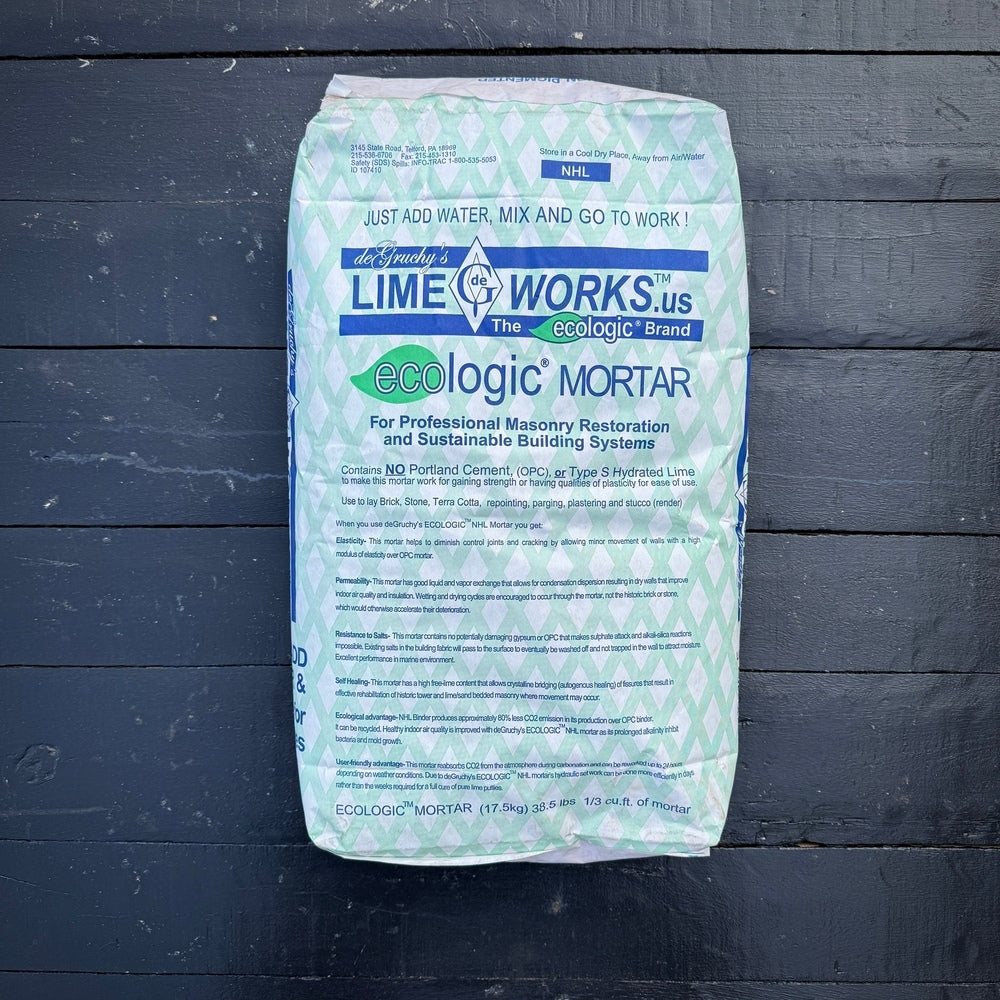
If you are putting this into practice, the Ecologic NHL 3.5 mortar we carry is a pre‑blended, non‑pigmented lime mortar in the coarse (G) grade for joints 3/8" and wider. It has a compressive strength of about 750 psi, in the same range as a Type N mortar, and water is the only thing you add. One 38.5 lb bag lays about 30 bricks with 1/2" joints. Our step-by-step mortar instructions cover mixing, laying, and curing, and Why Reclaimed Bricks Need Different Mortar Than New Bricks explains the performance side.
Ecologic NHL 3.5 mortar ships nationwide from our yard in Nanuet, NY. Add it to your cart and enter your address for a shipping quote. If it looks too high, call us at (718) 379-1232; we sometimes have alternative ways to get your order to your door for a more reasonable price. You can also see our reclaimed New York bricks in person at the yard; no appointment is needed, but if you call ahead at (718) 379-1232, we will make sure you get our full attention.
Share: