
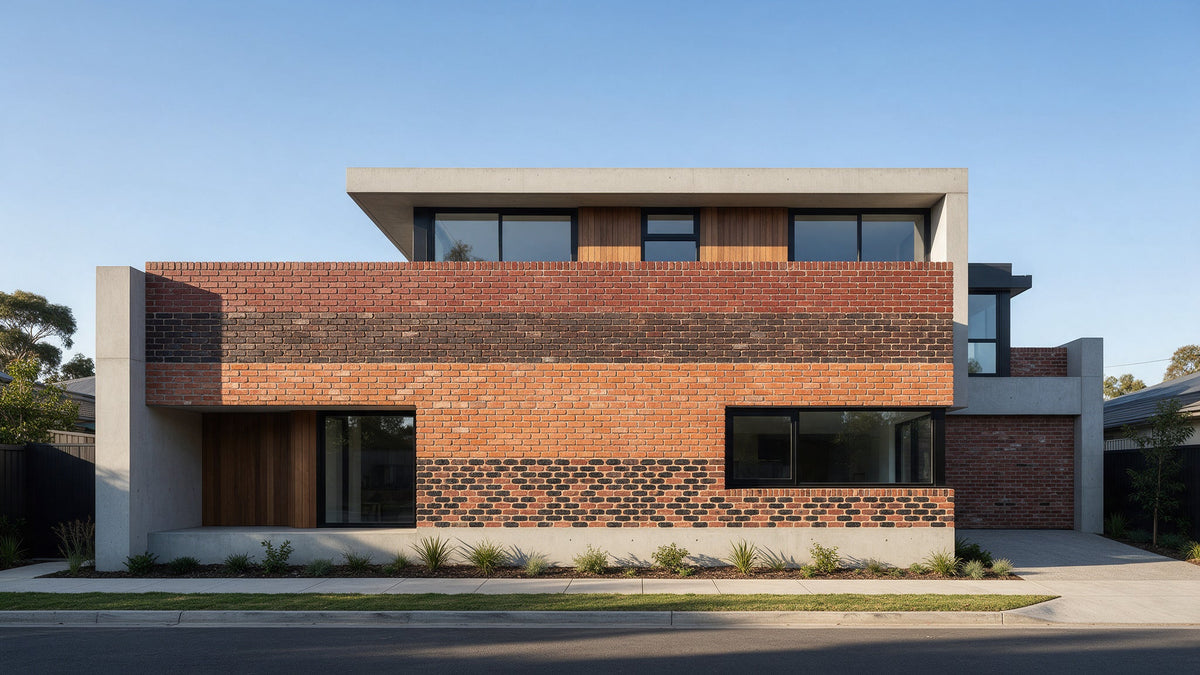
Look closely at a wall built from reclaimed brick and you can read it like a map. One band is deep red, the next is darker and speckled, and the one above has the warm orange of a different kiln. Each brick came from somewhere else. Put together with intent, they make something that looks nothing like a repair and everything like design.
This year, two winners at an international brick architecture award were built that way. One is a temple and museum in Vietnam made from millions of salvaged clay tiles. The other is new infill housing in Belgium whose walls are banded with brick from different old buildings. In both, the salvaged material is the point, not a compromise.
Maybe you are an architect who wants reclaimed brick to read as a modern choice, not a nostalgic one. You might be a designer looking for a way to bring reclaimed material into a new build without making it look like a renovation. Or maybe you are a homeowner planning an addition and wondering whether reclaimed brick can look contemporary. This guide breaks down what the winning projects did, and how to use the same ideas with reclaimed brick on a project here in the United States.
Table of Contents
- Making Reclaimed Brick Look Intentional at a Glance
- Two Award Winners Built From Salvage
- Lesson One: Variation Is the Design
- Lesson Two: Give Every Source Its Place
- Lesson Three: Keep Everything Else Simple
- Using These Ideas With American Reclaimed Brick
- Where Reclaimed Brick Works in a New Build
- Planning Quantities for a Banded or Blended Wall
- Joints, Bonds and Mortar
- Modern Interiors With Reclaimed Brick
- Can Reclaimed Brick Look Modern?
Making Reclaimed Brick Look Intentional at a Glance
The difference between a wall that looks designed and one that looks patched usually comes down to a few choices. This table sums them up.
| Choice | Looks intentional | Looks accidental |
|---|---|---|
| Color variation | Planned: a blend or bands chosen in advance | Whatever arrives on the pallet, laid at random |
| Mixing different bricks | Each type has a clear place, such as a band or a panel | Different types scattered without a pattern |
| Surrounding materials | Simple, modern frames, glass and trim | Fussy details that compete with the brick |
| Bond pattern | One clear bond, used consistently | Several patterns that fight each other |
| Joints | Even, consistent joints that let the brick lead | Joints that change width or color from area to area |
| Quantity | Every type ordered at once, with extra | A second order that does not quite match |
Note: these are design principles, not rules. Your architect or designer decides what suits a specific building.
Two Award Winners Built From Salvage
The top prize this year went to the Đạo Mẫu Temple and Museum, north of Hanoi in Vietnam, designed by ARB Architects. It was built from six million clay tiles collected from disused structures and houses.
A special commendation went to a housing infill on Tuighuisstraat in Kortrijk, Belgium, designed by Maker Architecten. Its walls are laid in horizontal bands of reclaimed brick, and each band is made from one kind of brick taken from a different building.
You can read more about the winners in Architectural Record's coverage of this year's awards.
The two projects are very different in scale and setting, but they share one idea. They treat salvaged clay as a design material in its own right, not as a cheaper or greener substitute for something new.
Lesson One: Variation Is the Design
New brick is usually made to be consistent. Reclaimed brick is not, and trying to make it look uniform is a losing battle. The winning projects go the other way: they make the variation the point.
A wall of reclaimed brick carries shifts in color, texture and wear that no new product can copy. When those shifts are planned, they read as richness. When they are left to chance, they can read as a patch job.
The practical step is to decide in advance what kind of variation you want. A calm, even blend across the whole wall gives a soft, textured surface. Bold contrasts between distinct types of brick give a stronger, more graphic look. Either can be beautiful, but each needs to be chosen on purpose.
Lesson Two: Give Every Source Its Place
The Kortrijk homes show a simple idea that works at any scale: give each kind of brick its own place in the wall. Instead of mixing everything together, each band comes from one source, so the wall reads as a set of clear layers.
The same idea works with bands, panels, or a change of brick between floors. A darker brick at the base and a lighter one above, a single contrasting band at window height, or a feature panel beside an entrance all give reclaimed brick a structure that looks designed.
The key is to keep each type together and repeat the pattern with intent. Random patches of different brick rarely look as good as a few clear, deliberate moves.
Lesson Three: Keep Everything Else Simple
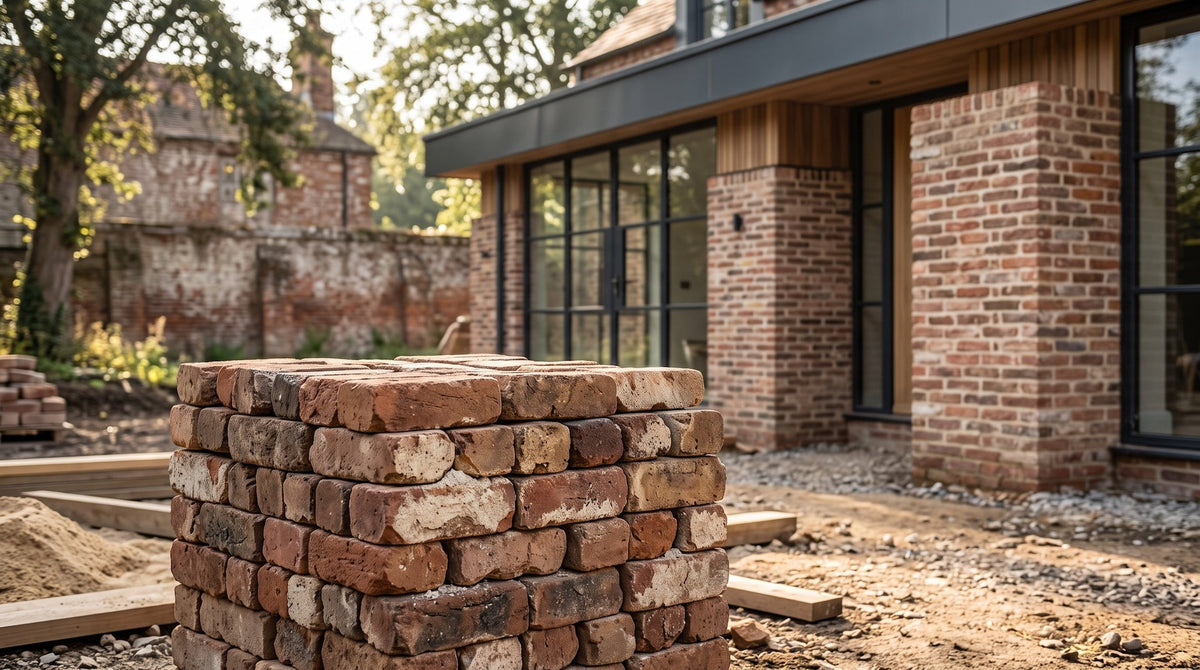
Reclaimed brick already has a lot to say. The projects that use it best tend to keep everything around it quiet: simple window frames, clean openings, plain trim and modern materials such as glass and steel.
That contrast is what makes reclaimed brick look contemporary. Next to crisp, modern details, the age and texture of the brick become a feature. Surrounded by imitation period details, the same brick can tip into pastiche.
Using These Ideas With American Reclaimed Brick
You do not need to look abroad for the material. All of our reclaimed brick comes from the United States, and much of it from New York. Our New York reclaimed bricks were made in the Hudson Valley, and they come in distinct types that lend themselves to blends and bands.
Our Reclaimed NY Red Bricks give a classic warm red. Our Reclaimed NY Dark Bricks carry deep, dark tones from long years of aging. Reclaimed NY Orange Bricks add a warmer hue, and Reclaimed NY Black Spot Rockland Bricks are marked with striking black spots and patches. For a bolder accent, Reclaimed NY Bump Bloat Clinker Bricks have distorted, bloated shapes that make every brick unique.
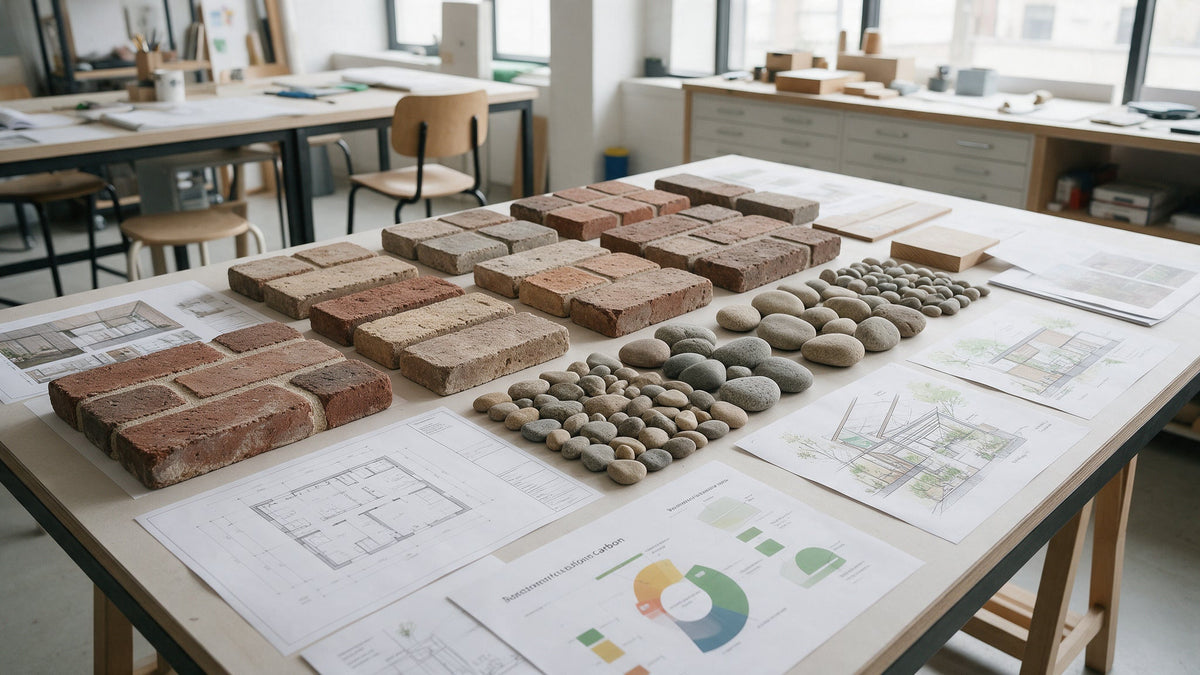
Each of these can be used on its own, blended, or set in bands like the Kortrijk homes. Because every type is sorted separately, you can plan exactly where each one goes.
Pictures are an indication only, and every brick is a little different. The best way to plan a blend or a banded wall is to see the brick in person. You are welcome to visit our yard in Nanuet, NY. No appointment is needed, but if you call ahead at (718) 379-1232, we will make sure you get our full attention. Many of our bricks are also available as a small sample by priority mail.
Where Reclaimed Brick Works in a New Build
Reclaimed brick does not have to cover a whole building to make an impact. In a new build, a few well-chosen places often do more than a full facade.
Feature walls and facades. A banded or blended wall facing the street, or a single brick volume set against glass or render, gives a new building a strong identity. Full reclaimed brick suits walls that are built as real masonry.
Garden walls and landscape. Low walls, planters and edges in reclaimed brick tie a new house to its garden and give the landscape instant age. For paths, patios and driveways, our Reclaimed Flint Street Brick Pavers were made to carry traffic, and each one carries the "Flint Co" stamp.
Interiors. A kitchen wall, a fireplace or a stair wall in reclaimed brick can anchor a modern interior. Thin brick wall veneer keeps the look without the weight, as covered below.
Details and accents. A band of clinker brick at a doorway, or a panel of darker brick beside an entrance, can give a plain new wall a point of interest without turning the whole building into a pattern.
Whichever you choose, match the brick to the job. Building bricks suit walls, fireplaces, patios and walkways, while street pavers are the ones to use where vehicles drive.
Planning Quantities for a Banded or Blended Wall
A banded or blended wall needs a little more planning than a wall of one brick, because each type has to be ordered in the right amount.
Start with the total wall area. For walls, plan on about 6.98 bricks per square foot with a 1/4-inch joint. Then work out how much of the wall each type will cover. For bands, measure the height of each band and multiply by the length of the wall. For a blend, decide the share of each type.
Add extra to each type separately: about 10% for simple layouts, and 12% to 15% for complex ones with many cuts, openings or corners. A banded wall depends on having enough of every type, and a shortfall in one band is hard to fix later. Our Masonry Brick & Stone Calculator helps with the math.
Order every type at once. Reclaimed brick varies from batch to batch, and the spares from the same order are the best way to repair the wall years from now.
Joints, Bonds and Mortar
When the brick is varied, the rest of the wall should stay consistent. Even joints of one width and one color let the brick lead and make a banded wall look crisp.
A single, clear bond pattern helps too. A running bond feels familiar and calm, while a stack bond, with every joint lined up, feels more modern and graphic. Our guide to brick bond patterns shows the options and where each one works.
For full reclaimed brick, use a breathable lime mortar. We carry Ecologic NHL 3.5 lime mortar, non-pigmented, for joints of 3/8 inch and wider. It is not meant for thin brick or floors, which use thin-set and grout. Our guide on why reclaimed bricks need different mortar than new bricks explains why lime suits reclaimed brick.
Modern Interiors With Reclaimed Brick
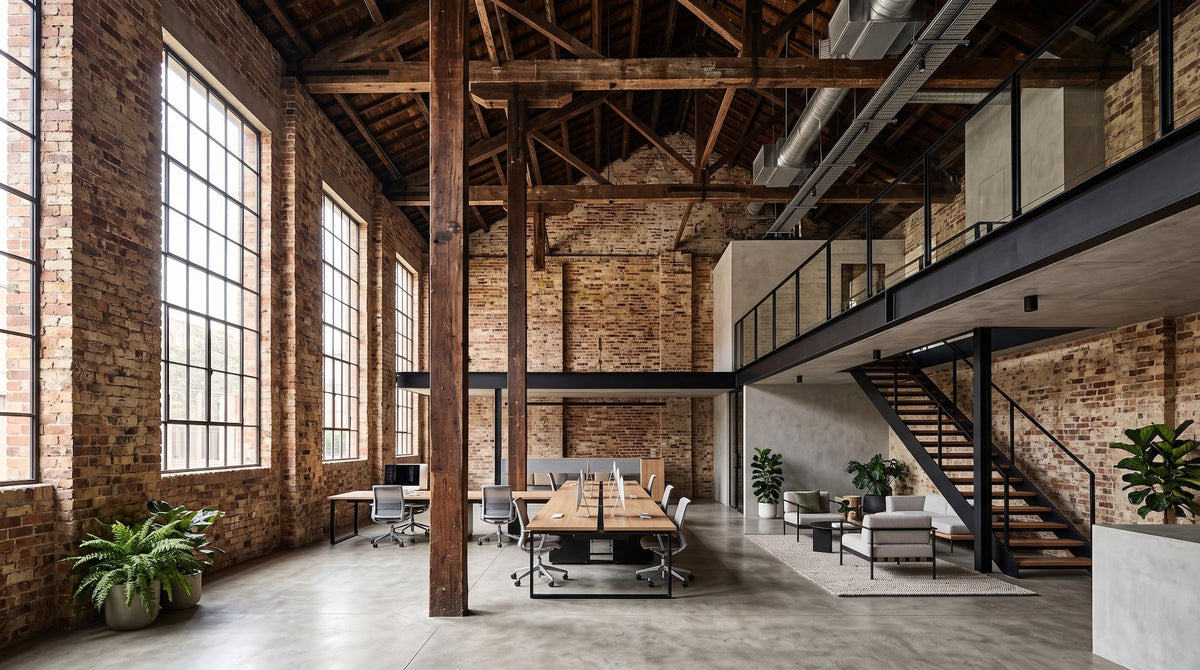
The same ideas work inside. A single wall of reclaimed brick in an otherwise clean, modern room can become the space's main feature, and bands or blends work just as well indoors.
For interior walls, thin brick wall veneer is often the most practical choice. Our Reclaimed NY Thin Brick Wall Veneer is cut from reclaimed full brick, so it has the same faces, color variation and wear, without the weight or thickness of a full masonry wall. It is for walls, not floors. Our guide to reclaimed thin brick veneer covers where it works best.
Can Reclaimed Brick Look Modern?
Yes. This year's award winners show that reclaimed clay can be the defining material of a contemporary building, not just a nod to the past. The secret is intent: planned variation, a clear place for every type of brick, and simple surroundings that let the material speak.
It takes more planning than ordering one uniform brick. Each type needs its own quantity, the full order should arrive at once, and a sample is worth seeing before you commit. Get those steps right, and reclaimed brick can look as deliberate as any new material.
If you are planning a contemporary project with reclaimed brick, start with our Reclaimed NY Red Bricks and Reclaimed NY Dark Bricks, or call us at (718) 379-1232 to talk through a blend.


Share: