Reclaimed bricks do not just appear on pallets ready to ship. Every unit started its life somewhere else: in a street carrying vehicles, as part of a factory wall, or lining an alley in a city that has changed completely since those bricks were first laid. Bringing those bricks back into circulation takes work, attention, and a clear process.
At Chief Bricks, sourcing, sorting, and grading reclaimed bricks is not a side project or an afterthought. It is the core of what we do. We work with salvage partners, demolition contractors, and site managers across the North East to identify historic brick that is worth saving, then we clean, sort, and grade it so you receive material that is ready to use in your patio, walkway, driveway, or building project. This guide walks you through that entire process, from finding bricks in the field to stacking them on trucks for delivery nationwide.
Table of Contents
- 1. Sourcing: where reclaimed bricks come from
- 2. The salvage process: lifting bricks from streets and buildings
- 3. Transport and initial inspection
- 4. Cleaning: removing mortar, debris, and surface buildup
-
5. Sorting by type, size, and character
- 6. Chief Bricks reclaimed brick inventory overview
- 7. Stacking, palletizing, and preparing for shipment
- 8. What you can expect when your order arrives
- 9. Our commitment to quality and authenticity
1. Sourcing: where reclaimed bricks come from
The first step in bringing reclaimed bricks to market is finding them. That means building relationships with demolition contractors, municipal street departments, salvage yards, and property owners who are tearing down old structures or resurfacing historic roads.
Reclaimed bricks come from several main sources. Street bricks are lifted when cities resurface old roads or convert brick-paved alleys to asphalt. Building bricks come from industrial sites, warehouses, factories, and older residential structures being demolished or renovated. Each source has its own character: street bricks tend to be denser and more uniform because they were made to handle vehicle loads, while building bricks show more variation and sometimes carry interesting markings or colors.
We actively look for bricks with proven durability, authentic patina, and sizes that work well in modern hardscape and building projects. Not every demolished building or repaved street yields usable reclaimed brick. Our job is to identify the batches worth saving before they end up in landfills or are crushed for fill material.
2. The salvage process: lifting bricks from streets and buildings
Salvaging reclaimed bricks is labor-intensive and requires care. Bricks set in mortar or embedded in old streets cannot simply be scooped up with heavy equipment without damaging them. The goal is to recover as many intact, reusable units as possible.
For street salvage, bricks are often lifted using jackhammers, pry bars, and hand tools. Workers break through the bedding layer and carefully separate individual bricks, shaking off loose sand and setting aside units that are cracked, broken, or too degraded to reuse. It is slow work, but it is the only way to preserve the material.
For building demolition, the process depends on whether the structure is being carefully deconstructed or torn down quickly. In selective deconstruction projects, bricks are removed course by course and stockpiled on site. In faster demolitions, bricks are separated from rubble after the building comes down, which means more breakage but also access to larger volumes of material.
3. Transport and initial inspection
Once bricks are lifted from their original location, they are transported to our yard in Nanuet, NY for processing. This is where the real work begins: turning a pile of old, mortar-covered bricks into clean and sorted stock ready for new projects.
As soon as material arrives, we conduct an initial inspection. We look at overall condition, check for consistent firing and density and assess color range. This early assessment helps us decide how much cleaning effort is justified and what the final product mix will look like.
Not every load of reclaimed brick makes the cut. If a batch is too soft, too heavily damaged, or inconsistent in a way that makes sorting impractical, we may reject it or designate it for non-structural uses like garden edging or fill. Our goal is to offer material we would use in our own projects, not just move volume.
4. Cleaning: removing mortar, debris, and surface buildup
Cleaning is one of the most visible steps in the reclaimed brick process. Bricks arrive covered in old mortar, dirt and decades of accumulated grime. Customers expect clean brick, and we deliver it through a combination of manual cleaning methods.
Manual cleaning involves hammers, chisels and sometimes wire brushes. We do not use any chemical treatments. Workers inspect each brick, tap off remaining mortar, and set aside units that need extra attention. This step is time-consuming, but it is what separates cleaned, ready-to-use reclaimed brick from a pile of salvage.
We do not over-clean. The goal is to remove mortar and prepare the brick for reuse, not to strip away all signs of age. A little surface texture, minor staining, or worn edges are part of the story. What we remove is anything that would interfere with installation or bonding in new projects.
5. Sorting by type, size, and character
After cleaning, bricks are sorted into categories based on type, size and color. This is where we start creating the distinct product lines you see in our inventory.
Type sorting separates street pavers from building bricks, full units from specialty pieces like clinkers or marked bricks from standard stock. Each type has different uses: dense street pavers go into driveways and high-traffic areas, building units work for indoor floors or veneers, and unique pieces become accents or focal points.
Size sorting groups bricks with similar dimensions together. While reclaimed material naturally has some variation, keeping dimensional tolerances within a reasonable range makes installation easier and patterns cleaner. Outliers that are significantly oversized or undersized are set aside for other uses or offered as accent pieces.
Character sorting is about color, patina, and markings. We separate dark bricks from red and orange ones. This allows us to create consistent batches and also offer specialty mixes for customers who want specific looks.
6. Chief Bricks reclaimed brick inventory overview
Our sourcing, sorting, and grading process results in a diverse inventory of reclaimed brick products, each with its own character and ideal uses. Below is an overview of the reclaimed brick types currently available at Chief Bricks.
Chief Bricks Reclaimed Brick Product Line
| Product Name | Description | Best Uses | Character Notes |
|---|---|---|---|
| Reclaimed New York Red Bricks | Dense building bricks salvaged from New York area demolition | Façades, walls, fireplaces, patios, walkways | Classic New York character with authentic urban patina |
| Reclaimed Dark Bricks (100+ years old) | Century-old bricks with deep, rich color tones from historic structures | Façades, feature walls, fireplaces, accent areas | Deep reds, browns, and charcoal tones with substantial age |
| Reclaimed Flat No Frog Floor Brick Pavers | Flat-faced pavers without frog indentations, ideal for smooth surfaces | Interior floors, patios, walkways | Clean face, minimal texture, easy to clean and seal |
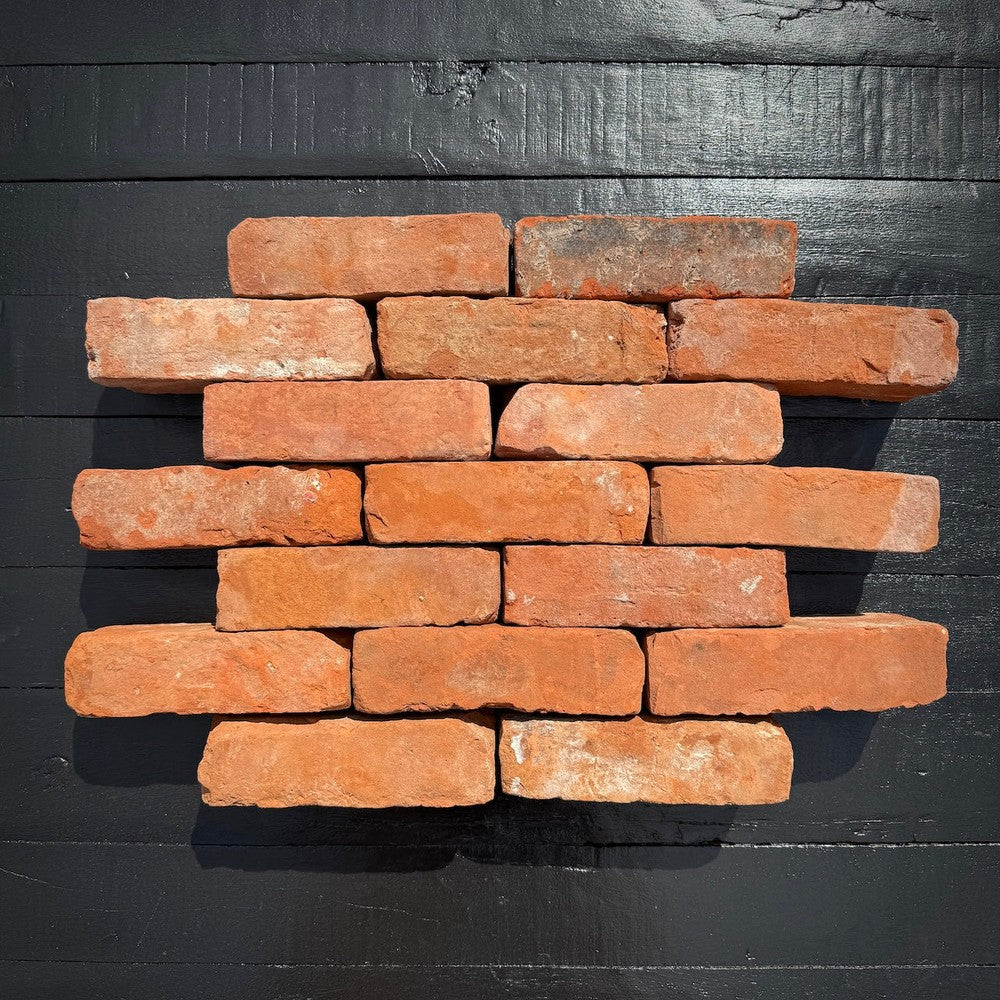
| Reclaimed New York Orange Bricks | Historic New York-area common bricks with warm color range | General construction, patios, garden walls | Warm and deep oranges |
| Reclaimed Black Spot Rockland Bricks | Distinctive bricks with characteristic black carbon spots from the firing process | Accent walls, decorative projects, unique patios | Black flashing and spots create striking visual interest |
| Reclaimed Bump Bloat Clinker Bricks | Over-fired bricks with warped, textured surfaces and unique shapes | Feature walls, artistic installations, garden accents | Highly irregular with dramatic texture and color variation |
| Reclaimed Street Brick Pavers | Historic street bricks | Garden paths, driveways, courtyards | Consistent size and varied colors with unparalleled solidity. |
| Reclaimed Back Up Three Quarter Bricks | Three-quarter length bricks originally used as structural bricks, but today missing 3 or 4 corners. | Edging, borders, cuts, small projects | Shorter length offers flexibility for tight spaces |
| New York Reclaimed Thin Brick Wall Veneer | Thin-cut reclaimed brick for interior and exterior wall applications | Interior accent walls, fireplace surrounds, backsplashes | Authentic reclaimed look with reduced weight and depth |
| New York Reclaimed Thin Brick Floor Tile | Thin-cut reclaimed brick designed specifically for floor installations | Mudrooms, sunrooms, kitchens, indoor floors | Historic character with tile-friendly thickness |
| Reclaimed Thin Brick Wall Corner Veneer | Pre-cut corner pieces for clean veneer installations around edges and openings | Corner details, window returns, architectural accents | Simplifies veneer corner details with matching patina |
Each of these products goes through the same rigorous sourcing, cleaning and sorting. The differences come from the original source material, the specific characteristics we identify during sorting, and how we prepare the bricks for their intended uses.
7. Stacking, palletizing, and preparing for shipment
Once bricks are cleaned and sorted, they are stacked on pallets for storage and shipment. This step might seem simple, but proper palletizing protects the bricks during transport and makes handling easier on both ends.
We stack bricks in stable, interlocking patterns that distribute weight evenly and resist shifting during transport. Pallets are banded with heavy-duty strapping and wrapped to keep bricks secure and protect them from weather during outdoor storage or cross-country shipping.
Each pallet is labeled with product type and exact count so you and your installer know exactly what you are receiving. For mixed orders or specialty requests, we mark pallets clearly and coordinate with customers to ensure the right material goes to the right project.
8. What you can expect when your order arrives
When you order reclaimed brick from Chief Bricks, you can expect material that has been sourced thoughtfully, cleaned thoroughly and sorted carefully.
You will receive bricks that are ready to use. Mortar is removed, surface debris is cleaned off, and pieces are inspected for structural soundness. There will still be authentic patina, surface texture, and the natural variation that makes reclaimed brick special, but you will not be spending hours chiseling mortar or discarding damaged units.
You will also receive consistency within the batch. Because we sort by color, the bricks on your pallet will fall within a predictable range of size, color, and condition. You may still want to mix from different pallets as you install to distribute variation evenly, but you will not be fighting wild inconsistencies or finding unusable pieces throughout the stack.
Finally, you will have transparency. We describe our products honestly, show representative photos, and answer questions about sourcing and suitability for specific projects. If a batch has more variation than usual, we say so. If certain bricks are better suited to patios than driveways, we make that clear upfront.
9. Our commitment to quality and authenticity
At Chief Bricks, sourcing, sorting, and grading reclaimed bricks is not just a process; it is a commitment to preserving history and delivering quality material to customers nationwide.
Every brick we sell started somewhere else, did its job for decades, and earned a second chance. Our role is to make that second chance possible by turning salvaged material into clean and sorted stock that is ready to become part of your home, your project, and your story.
We take that responsibility seriously because we know what is at stake. You are investing time, money, and vision into your patio, walkway, driveway, or building project. The bricks you choose are a foundational part of that investment, and they need to deliver on durability, appearance, and authenticity.
When you order from Chief Bricks, you are getting more than just old bricks. You are getting material that has been carefully sourced from real streets and buildings, cleaned and prepared by people who understand the difference between salvage and quality reclaimed stock.
That is our process, and that is our promise. From salvage site to your driveway, every step is designed to bring you the best reclaimed brick we can find, presented honestly and shipped reliably anywhere in the country.





Share: