

Reclaimed bricks already did their first tour of duty. They sat through decades of winters, summers, and sideways rain long before you decided to give them a second life. That history is exactly what makes them so attractive, but it also means they need a different kind of support system than brand‑new, hard‑fired units.
Mortar is the part of that support system most people underestimate. On paper, a stronger, harder mix sounds safer. In reality, reclaimed bricks usually perform best with mortars that are compatible in strength, flexible enough to move with the wall, and open enough to let moisture escape. This is where Natural Hydraulic Lime, and specifically NHL 3.5 mortar, comes in.
In this article, we will break down what NHL actually is, what the “3.5” means, and why this type of mortar is such a good match for reclaimed and historic brickwork. If you are planning a facade, a garden wall, or a feature interior with reclaimed bricks, this will help you understand why the right mortar matters as much as the bricks themselves.
Table of Contents
- What Is Natural Hydraulic Lime?
- What Does “3.5” Mean?
- How NHL 3.5 Behaves in a Wall
- Why Reclaimed Bricks Like NHL 3.5
- Ecologic NHL 3.5 for Reclaimed Bricks
- Where to Use NHL 3.5
- How NHL 3.5 Compares to Standard Mortar
- Questions to Ask Before You Specify
What Is Natural Hydraulic Lime?
Natural Hydraulic Lime starts life as limestone with naturally occurring clay and other minerals in it. When that stone is burned and processed, those impurities give the lime a useful twist: it can set in the presence of water (a hydraulic set) as well as through the slower process of carbonation. That is where the “hydraulic” part of the name comes from.
Instead of relying on Portland cement as the main binder, NHL mortars take advantage of this natural chemistry. They still cure and harden, but they do it with a different balance of strength, flexibility, and breathability than modern cement‑rich mortars. For older brickwork and reclaimed units, that balance matters more than raw compressive strength.
NHL is graded into different strength ranges, each suited to different types of masonry. NHL 3.5 sits in the middle of that spectrum. It is not the softest lime you can use, and it is not the hardest. That “in‑between” character is exactly what makes it so useful for reclaimed brickwork in real‑world weather.
What Does “3.5” Mean?
The number in NHL 3.5 is a strength class, not a random product code. It refers to an approximate compressive strength after curing, expressed in megapascals. In plain language, you can think of it as a way to say, “this is a moderate‑strength hydraulic lime.”
On the softer side, you find NHL 2, which is typically used for very gentle work, low‑stress interior applications, and extremely soft historic masonry. On the harder side, you find NHL 5, suited to higher‑load situations or more aggressive exposure where the masonry units themselves can handle it.
NHL 3.5 lands right in the middle. It offers enough strength for most brickwork while still giving you the flexibility and vapor permeability that reclaimed and historic materials need. Instead of locking a wall into a rigid, dense shell, it allows the assembly to move and dry in a more forgiving way.
How NHL 3.5 Behaves in a Wall
To understand why NHL 3.5 is useful, it helps to picture what is happening inside a wall over time. Bricks expand and contract with temperature and moisture. Buildings settle, wind pushes, and small movements happen season after season. Mortar has to respond to all of that without becoming the permanent weak point—or the thing that destroys the bricks.
NHL 3.5 mortar develops strength gradually. It gains an initial set faster than pure non‑hydraulic lime, but it continues to harden and refine over time. Because the binder is still lime at heart, the cured mortar can accommodate slight movements and distribute stress across the wall instead of concentrating it at a single hard joint.
Just as important, an NHL 3.5 joint remains vapor‑permeable. Moisture that creeps in through joints, hairline cracks, or the brick body is not trapped there. It can work its way back out as conditions change. That ability to breathe is a big part of why older masonry built with lime‑rich mortars has survived for over a century.
Why Reclaimed Bricks Like NHL 3.5
Reclaimed bricks did not grow up with modern cement mortars. Most of them were originally laid in softer, more forgiving mixes. Their cores can be less dense, their faces can be worn, and their edges hold a lot of small cracks and imperfections you do not see on factory‑fresh units.
When you pair that kind of brick with a very hard, very dense mortar, you change how the wall handles stress. Instead of the mortar taking the hit when things move or freeze, the brick faces start to fail. That shows up as flaking, spalling, and corners popping off—exactly the opposite of what you want when you have invested in reclaimed material.
NHL 3.5 is a better match because it behaves closer to the original mortars those bricks knew. It is strong enough to hold the wall together, but still soft and flexible enough to act as the sacrificial element. If something has to crack and be replaced decades from now, it is the joint, not the brick itself.
Ecologic NHL 3.5 for Reclaimed Bricks
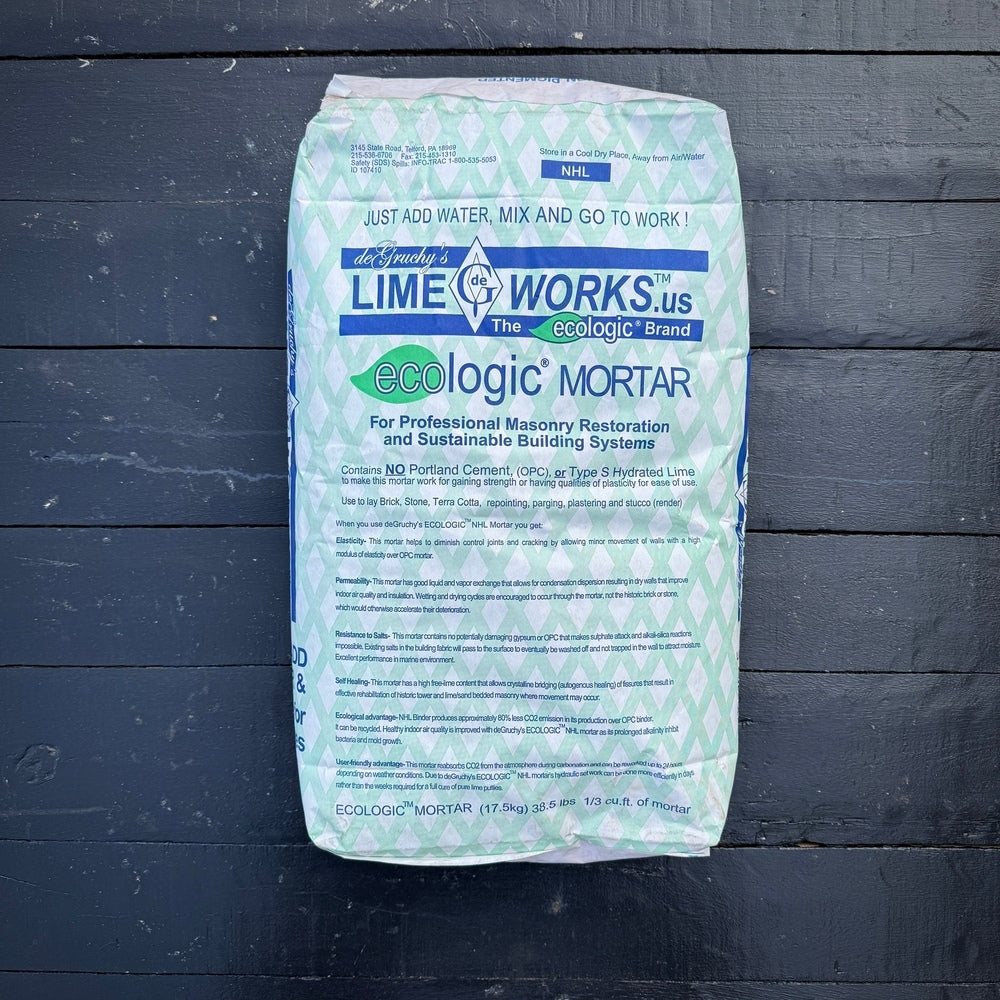
Ecologic NHL 3.5 Mortar for Reclaimed Bricks takes this raw material and packages it into a pre‑blended mix designed specifically for restoration and reclaimed masonry work. The lime binder is combined with carefully graded sands and optional pigments, so you do not have to build a mix from scratch every time you open a bag.
That matters for two reasons. First, consistency: each batch behaves the way the last one did, which is important when you are working across large facades or phased projects. Second, ease of use: on site, your mason is adding water and mixing, not juggling ratios and hoping every shovel of sand looks the same.
For reclaimed New York bricks in particular, this kind of ready‑to‑go NHL 3.5 mortar aligns with the realities of the material and the climate. You get joints that look right next to weathered brick faces and perform in a way that does not quietly punish the units over the next few winters.
Where to Use NHL 3.5
NHL 3.5 is a versatile class of mortar, but it is not meant to be absolutely everything to everyone. It shines in places where reclaimed or historic bricks need a reliable, compatible partner rather than a brute‑force solution.
Typical applications include exterior facades built from reclaimed brick, exposed garden and boundary walls, and repointing of existing reclaimed masonry where the bricks are still sound but the joints are failing. It also performs well on interior feature walls when you want the joints to age gracefully alongside the bricks, not turn into hairline‑cracked concrete ribbons.
If you are working on a heavily loaded structural element, or bricks that are significantly harder and denser than typical reclaimed stock, you may need to review whether NHL 3.5 is the right fit. The key is always the relationship between the brick and the mortar, not just the mortar by itself.
How NHL 3.5 Compares to Standard Mortar
Standard bagged mortars—those Type N, S, and M mixes you see at the yard—are usually built around Portland cement. They are easy to find, fast to use, and perfectly fine for many modern applications. For reclaimed brickwork, though, their strengths can become liabilities.
Compared to a typical cement‑rich mortar, NHL 3.5 will generally be less rigid, more vapor‑permeable, and more forgiving of small movements. It does not try to turn your reclaimed wall into a monolithic block. Instead, it respects the small shifts, temperature swings, and moisture cycles that older materials have always lived with.
This does not mean NHL 3.5 is “weaker” in a negative sense. It means the performance target is different. You are optimizing for compatibility and longevity of the brickwork, not just the strength of the joint on a lab chart.
Questions to Ask Before You Specify
Most of the value of NHL 3.5 shows up when it is chosen on purpose, not as an afterthought. If you are working with an architect, engineer, or mason, a few simple questions will help keep the project aligned with what your reclaimed bricks actually need.
- How old are the bricks, and how do they compare in strength to modern units?
- Is this wall structural, or is it a veneer backed up by a modern system?
- What kind of exposure will the assembly see—freeze–thaw, wind‑driven rain, road salt, irrigation?
- Can we specify an NHL 3.5 mortar that keeps the joints slightly softer and more breathable than the bricks?
- Do we need any specific color or texture in the joints to match existing work or a design intent?
Asking these questions early makes it clear that you are not just looking for the strongest mix on the shelf. You are aiming for a wall where the reclaimed bricks and the mortar work together, so the whole assembly ages in a way that feels natural instead of forced.
When you put that mindset together with a purpose‑made product like Ecologic NHL 3.5 Mortar for Reclaimed Bricks, the result is simple: walls that look like they belong and last like they should.
Share: